Hare Krsna,
[Note: This forum post will be academic in nature because I am trying to understand the concepts of incarnations, plenary portions and energies of the Lord better]
As Srila Prabhupada mentioned in his lecture, clearly understanding the difference between incarnations, plenary portions and energies of the Lord is complicated.
“So it is a very complicated idea, which of them is vaibhava, which of them is prābhava, which of them is vilāsa, which of them is tad-ekātmā, āveśa…” (Lecture on CC Madhya 20.164-173).
In this lesson we studied about prakasa and vilasa expansions of the Lord. Srila Prabhupada’s lecture focused on prabhava and vaibhava expansions of the Lord. I had some difficult reconciling these various expansion types. In order to understand these concepts better, I referred CC Madhya Chapter 20 (Lord Sri Caitanya Mahaprabhu Instructs Sanatana Goswami in the Science of the Absolute Truth). I am quoting some of the key verses here:
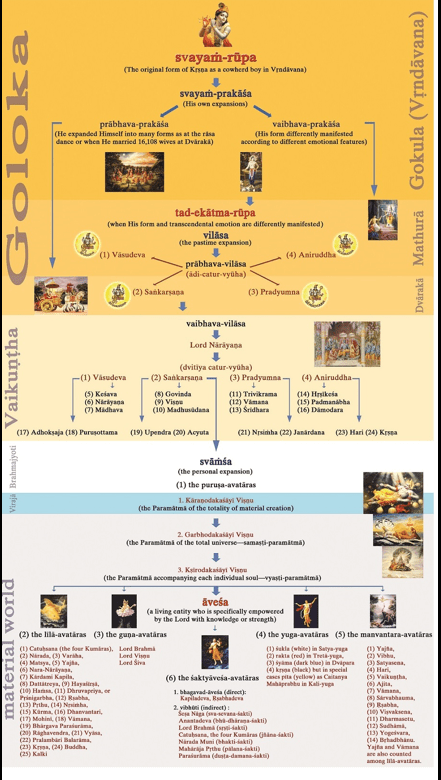
CC Madhya 20.165: The Supreme Personality of Godhead exists in three principal forms — svayaṁ-rūpa, tad-ekātma-rūpa and āveśa-rūpa.
CC Madhya 20.166: The original form of the Lord [svayaṁ-rūpa] is exhibited in two forms — svayaṁ-rūpa and svayaṁ-prakāśa. In His original form as svayaṁ-rūpa, Kṛṣṇa is observed as a cowherd boy in Vṛndāvana.
CC Madhya 20.167: In His original form, Kṛṣṇa manifests Himself in two features — prābhava and vaibhava. He expands His one original form into many, as He did during the rāsa-līlā dance.
CC Madhya 20.168: When the Lord married 16,108 wives at Dvārakā, He expanded Himself into many forms. These expansions and the expansions at the rāsa dance are called prābhava-prakāśa, according to the directions of revealed scriptures.
CC Madhya 20.171: If one form or feature is differently manifested according to different emotional features, it is called vaibhava-prakāśa.
CC Madhya 20.172: When the Lord expands Himself in innumerable forms, there is no difference in the forms, but due to different features, bodily colors and weapons, the names are different.
CC Madhya 20.174: The first manifestation of the vaibhava feature of Kṛṣṇa is Śrī Balarāmajī. Śrī Balarāma and Kṛṣṇa have different bodily colors, but otherwise Śrī Balarāma is equal to Kṛṣṇa in all respects.
CC Madhya 20.175: An example of vaibhava-prakāśa is the son of Devakī. He sometimes has two hands and sometimes four hands.
CC Madhya 20.176: When the Lord is two-handed He is called vaibhava-prakāśa, and when He is four-handed He is called prābhava-prakāśa.
CC Madhya 20.183: When that body is a little differently manifested and its features are a little different in transcendental emotion and form, it is called tad-ekātma.
CC Madhya 20.184: In the tad-ekātma-rūpa there are pastime expansions [vilāsa] and personal expansions [svāṁśa]. Consequently there are two divisions. According to pastime and personal expansion, there are various differences.
CC Madhya 20.185: Again the vilāsa forms are divided into twofold categories — prābhava and vaibhava. Again the pastimes of these forms are of unlimited variety.
CC Madhya 20.186: The chief quadruple expansions are named Vāsudeva, Saṅkarṣaṇa, Pradyumna and Aniruddha. These are called prābhava-vilāsa.
CC Madhya 20.188: Śrī Balarāma is a vaibhava-prakāśa manifestation of Kṛṣṇa. He is also manifested in the original quadruple expansions of Vāsudeva, Saṅkarṣaṇa, Pradyumna and Aniruddha. These are prābhava-vilāsa expansions with different emotions.
CC Madhya 20.191: From the original quadruple expansions, twenty-four forms are manifested. They differ according to the placement of the weapons in Their four hands. They are called vaibhava-vilāsa.
CC Madhya 20.207-208: All these twenty-four forms constitute the chief prābhava-vilāsa pastime forms of the Lord. They are named differently according to the position of the weapons in Their hands. Of all these, the forms that differ in dress and features are distinguished as vaibhava-vilāsa.
It is bit confusing to remember all these different incarnations and plenary portions of the Lord. Hence, I have attached a pictorial view that describes them better. As they say, a picture is worth a thousand words.
The energies of the Lord are relatively easier to understand.
CC Ādi 1.79-80 — The energies [consorts] of the Supreme Lord are of three kinds: the Lakṣmīs in Vaikuṇṭha, the queens in Dvārakā and the gopīs in Vṛndāvana. The gopīs are the best of all, for they have the privilege of serving Śrī Kṛṣṇa, the primeval Lord, the son of the King of Vraja.
These energies of the Lord are the sakti-tattvas, internal energies of the Lord.
In terms of offering respects to the different energies of the Lord, I always refer to the beautiful verse that Srila Krsnadas Kaviraja Goswami cited in Adi-lila 7.6.
CC Adi 7.6:
pañca-tattvātmakaṁ kṛṣṇaṁ
bhakta-rūpa-svarūpakam
bhaktāvatāraṁ bhaktākhyaṁ
namāmi bhakta-śaktikam
Let me offer my obeisances unto Lord Śrī Kṛṣṇa, who has manifested Himself in five as a devotee, expansion of a devotee, incarnation of a devotee, pure devotee and devotional energy.
Purport: Śrī Nityānanda Prabhu is the immediate expansion of Śrī Caitanya Mahāprabhu as His brother. He is the personified spiritual bliss of sac-cid-ānanda-vigraha. His body is transcendental and full of ecstasy in devotional service. Śrī Caitanya Mahāprabhu is therefore called bhakta-rūpa (the form of a devotee), and Śrī Nityānanda Prabhu is called bhakta-svarūpa (the expansion of a devotee). Śrī Advaita Prabhu, the incarnation of a devotee, is viṣṇu-tattva and belongs to the same category. There are also different types of bhaktas, or devotees, on the platforms of neutrality, servitude, friendship, parenthood and conjugal love. Devotees like Śrī Dāmodara, Śrī Gadādhara and Śrī Rāmānanda are different energies. This confirms the Vedic sūtra parāsya śaktir vividhaiva śrūyate. All these bhakta subjects taken together constitute Śrī Caitanya Mahāprabhu, who is Kṛṣṇa Himself.
The internal energies of the Lord such as the Laksmis in Vaikuntha, queens in Dvaraka, and gopis in Vrndavana fall under the category of bhakti-saktiman.
This single verse accommodates all the different manifestations of the Lord, and it a wonderful prayer to pray to all aspects of the Supreme Lord.
All glories to Srila Prabhupada!
 Krsna Katha