Hare Krsna,
The forum topic is ‘Uddhava’s spontaneous love’; I was meditating on the meaning of spontaneous love. There are two kinds of devotional service in practice (sadhana-bhakti) – vaidhi bhakti and raganuga bhakti. Vaidhi Bhakti means service according to regulative principles. Raganuga refers to the point at which, by following the regulative principles, one becomes a little more attached to Krsna and executes devotional service out of natural love. If one attains the stage of Raganuga bhakti, he cannot think of any other thing except Krsna. That is why, the people of Vrindavana were always thinking of Krsna spontaneously. Thus in this lesson we see that Uddhava’s displayed spontaneous love by remembering the childhood pastimes of Krsna.
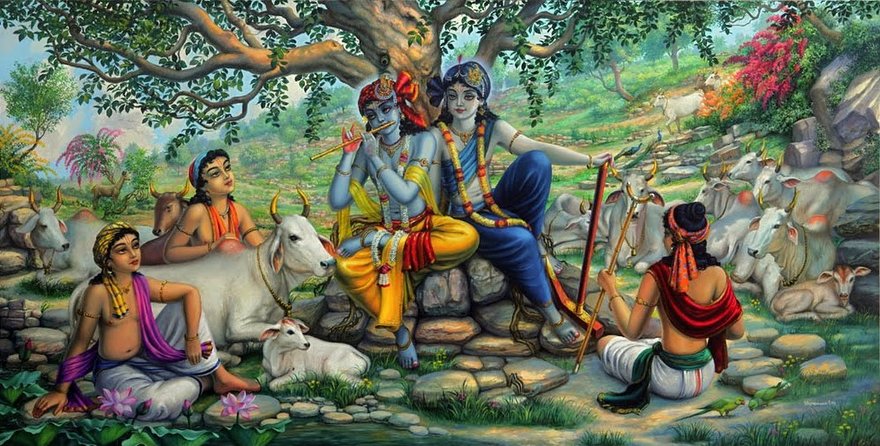
NOD 15: Examples of spontaneous devotional service can easily be seen in Kṛṣṇa’s direct associates in Vṛndāvana. The spontaneous dealings of the residents of Vṛndāvana in relationship with Kṛṣṇa are called rāgānugā. These beings don’t have to learn anything about devotional service; they are already perfect in all regulative principles and have achieved the spontaneous loving service of the Supreme Personality of Godhead. For example, the cowherd boys who are playing with Kṛṣṇa do not have to learn by austerities or penances or yogic practice how to play with Him. They have passed all tests of regulative principles in their previous lives, and as a result they are now elevated to the position of direct association with Kṛṣṇa as His dear friends. Their spontaneous attitude is called rāgānugā-bhakti.
To understand Kṛṣṇa means to understand Kṛṣṇa in His personal form with His internal energy, His external energy, His expansions and His incarnations. To meditate on Krsna means meditating on Krsna Himself, His form, qualities, pastimes, associates, abode, paraphernalia, etc. Because Krsna is the Absolute Truth, there is no difference between Krsna and His various aspects.
In this chapter, Uddhava displayed spontaneous love for Krsna by meditating on certain aspects of Krsna. There is a certain pattern in his meditation. In verses 12-14, he remembers the attractive beauty of the Lord. He remembered that the Lord’s form is the ornament of all ornaments. His beauty surpassed the dexterity of Brahma in creating beautiful objects. He also remembered the absorption of the gopis; he speaks this out of his own experience in Vraja, having seen their love. (SB 10-46-47)
In verses 15-24, Uddhava remembers Lord Krsna’s mercy and His bewildering activities such as His mercy to Sisupala and Putana. The bewildering acts of Krsna gave Uddhava distress. He remembers how Krsna, although unborn, took birth; He lived in Vraja out of fear of the enemy (even though He is feared by fear personified). Although all-powerful, He fled from Mathura. Although the Lord is all-powerful, He still submits before Ugrasena.
In verses 25-34, Udhava remembers the childhood pastimes of the Lord in Vraja. Although there is no difference between the Lord’s pastimes of appearance and disappearance, devotees do not generallt discuss about His disappearance. Therefore, Uddhava began narrating the pastimes of Krsna from His birth, although Vidura inquired him about the Lord’s disappearance. (SB 3.2.25)
In this way, Uddhava taught us how to meditate on Krsna in spontaneous love. The key point to note is that the meditation atttitude must be favorable to bhakti. “
NOD 15: The attraction of the gopīs for Kṛṣṇa and the affection of the members of the Yadu dynasty are both accepted as spontaneous, or rāgānugā. The attraction of Kaṁsa to Kṛṣṇa in fear and the attraction of Śiśupāla in envy are not accepted as devotional service, however, because their attitudes are not favorable. Devotional service should be executed only in a favorable frame of mind. Therefore, according to Śrīla Rūpa Gosvāmī, such attractions are not considered to be in devotional service. Again, he analyzes the affection of the Yadus. If it is on the platform of friendship, then it is spontaneous love, but if it is on the platform of regulative principles, then it is not. And only when affection comes to the platform of spontaneous love is it counted in the category of pure devotional service.
Uddhava’s meditation on Krsna childhood pastimes inspires me to study Krsna book regularly. It is amazing that Srila Prabhupada gave us the Krsna book first so that we can meditate on Krsna. By constantly meditating on Krsna and chanting His holy name, we become purified and qualified to return home, back to Godhead.
SB 2.1.6: The highest perfection of human life, achieved either by complete knowledge of matter and spirit, by practice of mystic powers, or by perfect discharge of occupational duty, is to remember the Personality of Godhead at the end of life.
All glories to Srila Prabhupada!
 Krsna Katha