Hare Kṛṣṇa,
My first thought while approaching this forum post was: what is the connection between the previous post and this one on Śrī Brahma-saṁhitā? Upon reflection, I believe the connection lies here.
Viśvanātha Cakravartī Ṭhākura’s Commentary on BRS 303 states that, “Those who have a desire to taste the sweetness of Rādhā and Kṛṣṇa in Vṛndāvana, but worship according to vaidhi-bhakti, using nyāsas and mudrās, do not attain Kṛṣṇa in Dvārakā with Rukmiṇī, because they do not have that aspiration. Nor can they attain Rādhā and Kṛṣṇa in Vṛndāvana, because they lack the worship on the path of rāga. Therefore, since they have a predominance of awareness of Kṛṣṇa as the Lord (āiśvarya-jñāna) in worship according to the path of rules, they attain Rādhā and Kṛṣṇa in a portion of Vṛndāvana called Goloka, in correspondence to that worship. It is understood that they do not attain the Vṛndāvana of pure sweetness.”
Further on in the same commentary, Viśvanātha Cakravartī Ṭhākura writes “What is called Goloka is but the majesty of Gokula. Gokula is known for its supreme sweetness. Goloka is a portion of Gokula which displays majesty. Goloka is but the majestic aspect of Gokula because Gokula displays a superior position.”
It is therefore essential to understand the relative positions of Gokula and Goloka.
Śrī Brahma-saṁhitā (2-5):
[The spiritual place of transcendental pastimes of Kṛṣṇa is portrayed in the second verse.] The superexcellent station of Kṛṣṇa, which is known as Gokula, has thousands of petals and a corolla like that of a lotus sprouted from a part of His infinitary aspect, the whorl of the leaves being the actual abode of Kṛṣṇa.
The whorl of that transcendental lotus is the realm wherein dwells Kṛṣṇa. It is a hexagonal figure, the abode of the indwelling predominated and predominating aspect of the Absolute. Like a diamond the central supporting figure of self-luminous Kṛṣṇa stands as the transcendental source of all potencies. The holy name consisting of eighteen transcendental letters is manifested in a hexagonal figure with sixfold divisions.
The whorl of that eternal realm Gokula is the hexagonal abode of Kṛṣṇa. Its petals are the abodes of gopīs who are part and parcel of Kṛṣṇa to whom they are most lovingly devoted and are similar in essence. The petals shine beautifully like so many walls. The extended leaves of that lotus are the gardenlike dhāma, i.e. spiritual abode of Śrī Rādhikā, the most beloved of Kṛṣṇa.
A visual aid would be helpful here. Fortunately, several images depict this transcendental realm beautifully — the one I find most clear and illuminating is this:
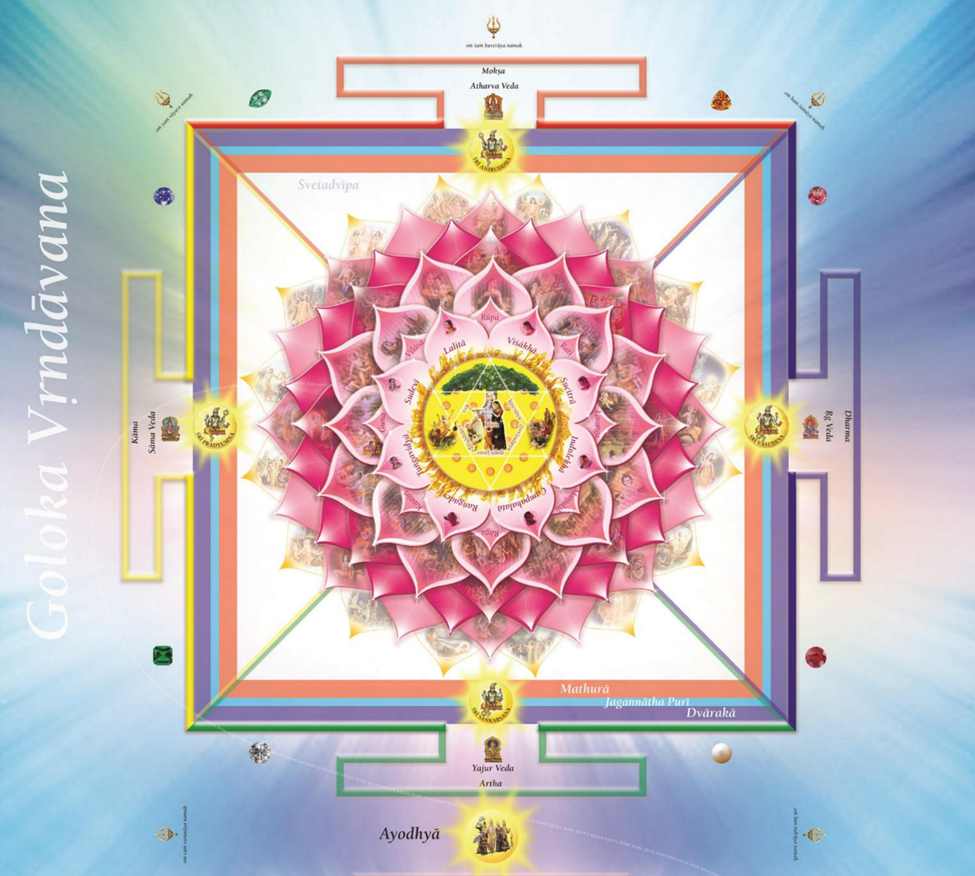
In his purport to CC Adi 5.18-19, Srila Prabhupada gives us a detailed description of Goloka Vrindavana, the Supreme Abode:
“The abode known as Vṛndāvana or Gokula is also known as Goloka. The Brahma-saṁhitā states that Gokula, the highest region of the kingdom of God, resembles a lotus flower with thousands of petals. The outer portion of that lotuslike planet is a square place known as Śvetadvīpa. In the inner portion of Gokula there is an elaborate arrangement for Śrī Kṛṣṇa’s residence with His eternal associates such as Nanda and Yaśodā. That transcendental abode exists by the energy of Śrī Baladeva, who is the original whole of Śeṣa, or Ananta. The tantras also confirm this description by stating that the abode of Śrī Anantadeva, a plenary portion of Baladeva, is called the kingdom of God. Vṛndāvana-dhāma is the innermost abode within the quadrangular realm of Śvetadvīpa, which lies outside of the boundary of Gokula Vṛndāvana.”
This Supreme Lotus is placed on the divine island of Śvetadvīpa, which is quadrangular. On the outskirts of Svetadvipa, there are three concentric islands with the realms of Mathura, Jagannatha Puri, and Dvaraka. Outside of it is Ayodhya.
Prabhupada comments on this point in his purport to CC Adi 5.18:
“From the authoritative evidence cited by Jīva Gosvāmī we may conclude that Kṛṣṇaloka is the supreme planet in the spiritual sky, which is far beyond the material cosmos. For the enjoyment of transcendental variety, the pastimes of Kṛṣṇa there have three divisions, and these pastimes are performed in the three abodes Dvārakā, Mathurā and Gokula. When Kṛṣṇa descends to this universe, He enjoys the pastimes in places of the same name. These places on earth are nondifferent from those original abodes, for they are facsimiles of those original holy places in the transcendental world. They are as good as Śrī Kṛṣṇa Himself and are equally worshipable. Lord Caitanya declared that Lord Kṛṣṇa, who presents Himself as the son of the King of Vraja, is worshipable, and that Vṛndāvana-dhāma is equally worshipable.”
What does all of this mean for sincere practitioners of bhakti who aspire to walk in the footsteps of the gopīs? The essence, I believe, can be distilled into this:
“The devotee actuated by knowledge (jñāna-bhakta), the devotee actuated by the pure devotional aptitude (śuddha-bhakta), the devotee imbued with loving devotion (prema-bhakta), the devotee actuated by pure love (premapara-bhakta), and the devotee impelled by overwhelming love (premātura-bhakta), who serve the majesty of Godhead, have their locations in Vaikuṇṭha, i.e., the transcendental realm of Śrī Nārāyaṇa.
The devotees who are imbued with all-love and who walk in the footsteps of the spiritual maids of Vraja, alone attain to the realm of Goloka. The different locations of the devotees in Goloka according to the respective differences in the nature of their rasa, i.e., mellow quality, are settled by the inconceivable power of Kṛṣṇa. The pure devotees following the devotees of Vraja and those following the pure devotees of Navadvīpa are located in the realm of Kṛṣṇa and Gaura respectively. The identical devotees of Vraja and Navadvīpa simultaneously attain to the pleasures of service in the realm of Kṛṣṇa and Gaura.” (Purport to Śrī Brahma-saṁhitā Text 5)
What is particularly wonderful is that Gauḍīya Vaiṣṇavas — followers of Śrī Caitanya Mahāprabhu — are not deprived of any of these transcendental treasures.
“The selfsame Gauracandra, who is no other than Kṛṣṇa Himself, in order to taste the rasa of the pastimes of Rādhā-Kṛṣṇa in Goloka, is manifest in the eternal realm of Navadvīpa identical with Goloka. Just as Śrī Kṛṣṇa had His birth in the mundane Gokula through the agency of Yogamāyā who is the primal energy of the Supreme Lord, so with her help He manifests the līlā of His birth in the womb of Śacī-devī in Navadvīpa on this mundane plane.
The gist of the whole matter is this—Goloka as Śvetadvīpa is eternally manifest because the pleasures of enjoyment of the rasa could not be had in its entirety in the pastimes of Kṛṣṇa in Vraja.” (Purport to Śrī Brahma-saṁhitā Text 5)
In essence, Gauḍīya Vaiṣṇavas are not deprived of anything. They too attain the transcendental realm of Gokula — specifically Śvetadvīpa, their eternal place of abode within Goloka. Śvetadvīpa in Goloka is their place of abode.
All glories to Śrīla Prabhupāda!
 Krsna Katha