SB 10.32.17-22: Kṛṣṇa Answers the Gopis’ Question

Hare Kṛṣṇa,

I find the gopīs’ question and Kṛṣṇa’s response especially meaningful and worthy of summarizing.

The gopis asked Krsna, “Some people reciprocate the affection only of those who are affectionate toward them, while others show affection even to those who are indifferent or inimical. And yet others will not show affection toward anyone. Dear Kṛṣṇa, please properly explain this matter to us.” (SB 10.32.16)

  • Motivated: Those who reciprocate only to those who show them affection.
  • Unmotivated: Those who reciprocate even with those who are hostile.
  • Indifferent: Those who don’t show affection toward anyone.

By this apparently polite question, the gopis want to expose Lord Krsna’s failure to properly reciprocate their love. They wanted to ask Him, “O Krsna, do you have affection for us, indifferent to us, or hostility towards us?

Krsna then explains the three categories of reciprocators. (Paraphrased from SB 10.32.18-19)

  • First category – selfish, without true friendship, or dharma.
  • Second category – genuinely merciful, naturally affectionate like parents, true well-wishers and followers of dharma.
  • Third category – has four subcategories
    • Spiritually self-satisfied (ātmārāmā)
    • Materially fulfilled (āpta-kāmā)
    • Ungrateful (akṛta-jnā)
    • Envious of superiors (guru-druha)

We frequently observe this phenomenon in the material world. Those who show respect to others with expectations of personal gain are, in reality, concerned only with their own present and future benefits. Such respect is ultimately self-centered rather than genuinely directed toward others. True friendship, however, is free from selfish motives and rests solely on love for one’s friend.

This pure quality of friendship is evident in Kṛṣṇa’s dealings with the Pāṇḍavas and Sudāmā Vipra. Kṛṣṇa’s relationship with the jīvas, who are His parts and parcels, is never transactional. In fact, due to His supremely independent nature, Kṛṣṇa does not belong to any of the three aforementioned categories.

Although Kṛṣṇa appears to act in human-like ways through His pastimes, everything He does is completely transcendental. He cannot be fully grasped by our material senses, mind, or intelligence. Reflecting on this, it becomes easier to understand why Kṛṣṇa does not fit into our limited categories, and why the reasons behind His actions are often beyond our comprehension. With this understanding, we can now look more carefully at how Kṛṣṇa explains to the gopīs why He did not immediately reciprocate with them.

Krsna says:

But the reason I do not immediately reciprocate the affection of living beings even when they worship Me, O gopīs, is that I want to intensify their loving devotion. They then become like a poor man who has gained some wealth and then lost it, and who thus becomes so anxious about it that he can think of nothing else.” (SB 10.32.20)

My dear girls, understanding that simply for My sake you had rejected the authority of worldly opinion, of the Vedas and of your relatives, I acted as I did only to increase your attachment to Me. Even when I removed Myself from your sight by suddenly disappearing, I never stopped loving you. Therefore, My beloved gopīs, please do not harbor any bad feelings toward Me, your beloved. (SB 10.32.21)

I am not able to repay My debt for your spotless service, even within a lifetime of Brahmā. Your connection with Me is beyond reproach. You have worshiped Me, cutting off all domestic ties, which are difficult to break. Therefore please let your own glorious deeds be your compensation. (SB 10.32.22)

Although the gopis were already perfect in their love for Krsna, still, to inconceivably increase their perfections and show an example for the world, Krsna acted as He did.

This is an important lesson for us. At times, I find myself tempted to wonder why Kṛṣṇa does not seem to reciprocate with my sādhana and prayers. The reality, however, is that my attachment to Kṛṣṇa is still very weak—certainly not comparable to that of the gopīs. Furthermore, as we can understand from Kṛṣṇa’s reasoning above, He does not always reciprocate immediately because He desires our attachment to Him to deepen and mature. In this way, He nurtures our longing, almost to the point that we develop an intense greed to attain Him alone.

Kṛṣṇa: “In this way I am actually merciful. It is desirable for My worshipers to have this complete attachment to Me. Thus to increase that attachment more and more, I, even though externally failing to reciprocate with them, invisibly reciprocate very much with them.

“Although you gopis are the ideal examples of those who worship even those who do not worship them, I too am actually very merciful, as much as you are, since I have given you the gift of My darsana. One should not think that only if I am present that I respond, and if I am absent I do not respond. For then My promise, ye yathā māṁ prapadyante tāṁs tathaiva bhajāmy aham, ‘I will respond accordingly as they worship Me’ (Bg. 4.11) would be broken.” (Sārārtha-darśini, SB 10.32.20)

The final highlighted section offers great relief and hope. It affirms that Kṛṣṇa indeed hears our chanting and prayers, even though His response may not always align with our expectations.

All glories to Srila Prabhupada!

SB 10.32.10-16: The Gopis Inquiry About Different Types of Loving Reciprocation

Hare Kṛṣṇa,

In this lesson, a particular section stood out for me.

“The śrutis attained the highest platform of desire fulfillment. Upon seeing Kṛṣṇa enjoying with the gopis, the śrutis thought, “When will we become Vraja-gopis and offer the kunkuma-tinged shawls from our breasts as seats for Kṛṣṇa?” The Brhad-Vamana Purana says the śrutis, following in the footsteps of the gopis, executed severe austerities in order to attain bodies of gopis. Therefore the śrutis, or personified Vedas, prayed in the Srimad Bhagavatam (10.87.23) as follows: “The women of Vraja attained the nectar of Kṛṣṇa’s lotus feet after having their intelligence vanquished by the sharp poison of His beautiful serpentine arms. By following in their footsteps, we too will become gopis and serve Kṛṣṇa’s lotus feet.” (SB 10.32.13: Sārārtha-darśini)

I looked up SB 10.87.23 for further explanation of this verse. Fortunately, there is an extensive purport to this verse. I would like to quote a few excerpts from the purport.

Speaking for themselves, however, the personified Vedas here state that they would prefer to develop love of Godhead by learning to emulate the favorable surrender of Lord Kṛṣṇa’s confidential devotees, especially the young gopīs of Vraja. Though they appeared to be simple women attracted conjugally to the Lord’s physical beauty and strength, the goddesses of Vraja exhibited the highest perfection of meditation. The śrutis wish to become just like them.

In this regard, Lord Brahmā relates the following historical account in the supplement to the Bṛhad-vāmana Purāṇa:

“The infinite world of spiritual bliss is called Vaikuṇṭha. There the Supreme Truth lives, being glorified by the personified Vedas, who are also present there.”

“Once, after the Vedas had elaborately praised Him, the Lord felt especially satisfied and spoke to them in a voice whose source remained invisible: ‘My dear sages, I am very satisfied with you. Please ask of Me some benediction that you secretly desire.’”

“The śrutis replied, ‘We have developed the desire to become like the cowherd women of the mortal world who, inspired by lust, worship You in the mood of a lover.’”

“The Lord then said, ‘This desire of Yours is difficult to fulfill. Indeed, it is almost impossible. But since I am sanctioning it, your wish must inevitably come true.’”

“‘When the next Brahmā takes birth to faithfully execute his duties of creation, and when the day of his life called the Sārasvata-kalpa arrives, you will all appear in Vraja as gopīs.’”

“‘On the earth, in the land of Bhārata, in My own district of Mathurā, in the forest of Vṛndāvana, I will become your beloved in the circle of the rāsa dance.’”

“‘Thus obtaining Me as your paramour, you will all gain the most exalted and steadfast pure love for Me, and in this way you will fulfill all your ambitions.’”

“Lord Brahmā said: After hearing these words, the śrutis meditated on the Personality of Godhead’s beauty for a long time. When the designated time ultimately arrived, they became gopīs and obtained the association of Kṛṣṇa.”

Regarding the development of bhakti, Lord Kṛṣṇa further states in the Gopāla-tāpanī Upaniṣad (Uttara 4) “By remembering Me, one who is impure becomes pure. By remembering Me, one who follows no vows becomes a strict follower of vows. By remembering Me, one who is desireless develops desires [to serve Me]. By remembering Me, one who has studied no Vedic mantras becomes an expert knower of the Vedas.”

And here is the key takeaway:

All honest Vaiṣṇavas, however, join in adhering to the devotional service of the Supreme Lord, always meditating with pleasure on His infinitely wonderful, variegated spiritual qualities. In the words of the śruti-mantras, yam evaiṣa vṛṇute tena labhyas/ tasyaiṣa ātmā vivṛṇute tanūṁ svām: “To that person whom the Supreme Soul chooses, He becomes attainable. To that person the Supreme Soul reveals His personal form.” (Kaṭha Upaniṣad 1.2.23 and Muṇḍaka Upaniṣad 3.2.3)

Śrīla Śrīdhara Svāmī concludes with the prayer, “O Lord, loving remembrance of Your lotus feet is very rarely achieved. Please, O Nṛhari, somehow arrange for me to have that remembrance day and night.”

So the key takeaway point is man proposes; God disposes. All our desires can be fulfilled by the Supreme Lord. True intelligence is what best to desire. Here the personifies srutis were not carried away by the desires of mystic yoga or attaining Brahman. They rather preferred to associate with Krsna as the gopis. This is precisely the mood that Sri Caitanya Mahaprabhu appeared to give us,

I identify Myself only as the servant of the servant of the servant of the lotus feet of Lord Śrī Kṛṣṇa, the maintainer of the gopīs.” (CC Madhya 13.80)

All glories to Srila Prabhupada!

SB 10.32.1-9 – The Reunion

Hare Kṛṣṇa,

The word “reunion” itself is deeply enchanting. It dissolves the long-accumulated pain of separation and pours soothing relief into the eyes that finally behold the beloved once more. It softens and melts the hearts that have cried in longing, transforming bitterness into sweetness and sorrow into joy. In reunion, love does not merely return—it deepens and becomes ever more precious. Just as a weary traveler finds peace upon returning home after a long and difficult journey, reunion with the beloved Lord drives away all exhaustion, fills the heart with solace, and restores the soul to its true resting place.

Text 9 beautifully sums up the mood of reunion.

All the gopīs enjoyed the greatest festivity when they saw their beloved Keśava again. They gave up the distress of separation, just as people in general forget their misery when they gain the association of a spiritually enlightened person.”

Similarly, the gopis had their air of life reenter their bodies after Sri Kṛṣṇa returned. Each gopi welcomed the reunion in her own loving way.

“One gopī joyfully took Kṛṣṇa’s hand between her folded palms, and another placed His arm, anointed with sandalwood paste, on her shoulder. A slender gopī respectfully took in her joined hands the betel nut He had chewed, and another gopī, burning with desire, put His lotus feet on her breasts. One gopī, beside herself with loving anger, bit her lips and stared at Him with frowning eyebrows, as if to wound Him with her harsh glances. Another gopī looked with unblinking eyes upon His lotus face, but even after deeply relishing its sweetness She did not feel satiated, just as mystic saints are never satiated when meditating upon the Lord’s feet. One gopī took the Lord through the aperture of her eyes and placed Him within her heart. Then, with her eyes closed and her bodily hairs standing on end, she continuously embraced Him within. Thus immersed in transcendental ecstasy, she resembled a yogī meditating upon the Lord.” (SB 10.32.4-8)

This teaches us that each soul shares a unique and personal loving relationship with our Lord, Śrī Kṛṣṇa. According to the nature and depth of one’s love and devotion, Kṛṣṇa reciprocates perfectly in return. Thus, regardless of the particular rasa one shares with Him, every devotee feels fully complete and perfectly satisfied within their own sthāyī-bhāva. There is no sense of lack or longing for another rasa—no thought of “I wish my relationship were different.” The cowherd boys delight entirely in their sakhya-rasa with Kṛṣṇa and harbor no desire for any other mood. Similarly, Mother Yaśodā, immersed in her vātsalya-bhāva, feels wholly fulfilled in her affectionate service to Kṛṣṇa. This harmonious completeness, born of Kṛṣṇa’s perfect reciprocation with each devotee, is the exquisite beauty of our eternal relationship with Him.

Another profound realization from this lesson is that Kṛṣṇa, too, experiences the pain of separation from the gopīs. In the earlier chapters, we witness the gopīs’ intense anguish as they are torn apart from Him, and a reader might be forgiven for momentarily thinking that Kṛṣṇa appears hard-hearted in allowing them to suffer so deeply. Yet here we are shown that Kṛṣṇa Himself also suffers in separation. His apparent detachment is not indifference, but a deeper expression of love—one that shares fully in the pain it seems to cause.

Although Kṛṣṇa’s lotus face blossomed with a smile, the suffering of the gopis pained His lotus heart. Kṛṣṇa appeared before the gopis with a yellow shawl draped across His shoulders and hanging down on both sides of His chest. Folding His hands, Kṛṣṇa begged them for forgiveness. “ (SB 10.32.2 Sārārtha-darśini)

Lastly, I had the pleasure of reading how Srila Visvanatha Cakravarti Thakura establishes the supreme position of Śrī Rādhā. devī kṛṣṇa-mayī proktā, rādhikā para-devatā, sarva-lakṣmī-mayī sarva, kāntiḥ sammohinī parā Sri Radha is the most beautiful, supremely worshipable goddess. Radha is always totally absorbed in Kṛṣṇa. Radha is the central figure for all the goddesses of fortune. Radha fulfills all of Kṛṣṇa’s desires, and completely enchants His mind. Radha is the inseparable internal potency of Kṛṣṇa.” (SB 10.32.8 Sārārtha-darśini)

The following section is even more remarkable, as it can be directly correlated with the Hare Kṛṣṇa mahā-mantra.

“The Åg-pariśiṣṭa (a supplement to the Åg Veda) says: “Madhava together with Radha, and Radhika together with Madhava are the most radiantly attractive persons in the whole universe.” (SB 10.32.8 Sārārtha-darśini)

According to the mood of aisvarya, ‘Rama’ refers to Ramacandra, the son of Dasaratha. According to the mood of madhurya, ‘Rama’ refers to Krsna, the relisher of Sri Radha’s association. Whenever the Name ‘Rama’ indicates service to Radha-ramana Krsna, then the word ‘Hare’ which is the vocative form of Hara, refers to Sri Radharani, who is the origin of all spiritual potencies. Sri Radha is known as Hara because She attracts the mind of Krsna. Hari means ‘attracter’. Hare is the vocative form of the word ‘Hara’. There are three Ramas – Rama, the husband of Sita-devi, Rama the husband of Revati and Rama, the lover of Radha.” (Sri Srila Prabhupader Upadesamrta)

Thus ‘Rama’ in the Hare-Krsna maha-mantra indicates Radha-Ramana (or Radha-Madhava – another form of Radha-Ramana).

It is amazing how everything in the rāsa-līlā and Kṛṣṇa’s intimate pastimes with the gopīs ultimately converge in the Hare Kṛṣṇa mahā-mantra.

All glories to Srila Prabhupada!

SB 10.31.19 – Realizations On SB 10.31.19

Hare Kṛṣṇa,

SB 10.31.19: O dearly beloved! Your lotus feet are so soft that we place them gently on our breasts, fearing that Your feet will be hurt. Our life rests only in You. Our minds, therefore, are filled with anxiety that Your tender feet might be wounded by pebbles as You roam about on the forest path.

The gopīs’ love for Kṛṣṇa is as deep as a bottomless ocean and as vast as an endless expanse of sky. Such love is inconceivable and wholly unimaginable to the material mind.

Who other than the most exalted gopīs’ can say “Those extremely tender lotus feet, which we hesitate to place upon our breasts for fear of injuring them, are wandering about in the forest.” (SB 10.31.19 Sārārtha-darśini)

Or “O dear one! We hold them because we see that You gain satisfaction when Your feet are held on our breasts. Seeing that You derive pleasure from pressing Your feet on our breasts, we accept that, but we experience grief imagining that Your tender feet are feeling pain. Therefore, we will hold them very carefully.” (SB 10.31.19 Sārārtha-darśini)

Or “Our lives are only in You, for our life is You. As long as You are comfortable, then even if we have to suffer this much tribulation, we will remain alive. “ (SB 10.31.19 Sārārtha-darśini)

These statements are possible to be made by one who has intense prema for Kṛṣṇa. This is a state of maha-bhava. The gopis’ feeling of grief in fearful anticipation of the beloved’s distress, even in the midst of a mood of intimacy, is a symptom of mahā-bhāva. 

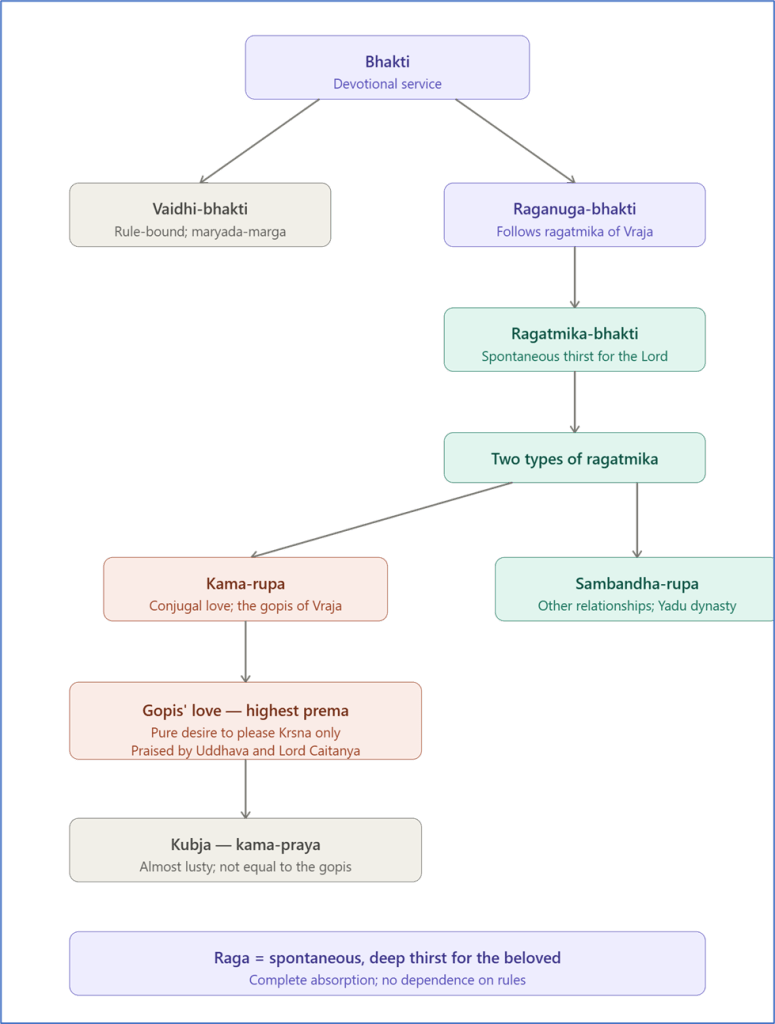
The gopis are the most exalted devotees of Kṛṣṇa because they have given up social customs, scriptural injunctions, bodily demands, fruitive action, shyness, patience, bodily pleasures, self-gratification, the path of varṇāśrama-dharma, as well as their own relatives and their punishment and scolding, for the sake of serving Lord Kṛṣṇa. (CC Adi 4.167-169)

Their relationship with Kṛṣṇa is only for the sake of His enjoyment. There is not the slightest taint of lust in the gopīs’ love. The gopīs do not care for their own pleasures or pains. All their physical and mental activities are directed toward offering enjoyment to Lord Kṛṣṇa. Among the gopīs, there is not a pinch of desire for sense gratification. Their only desire is to give pleasure to Kṛṣṇa, and this is why they mingle with Him and enjoy with Him.” (CC Adi 4.172, 174, 218)

The speciality of gopīs’s bhava is that it is pure, uncontaminated emotion. They have no knowledge or consciousness of the Lord’s opulence (aiśvarya-jñāna-yukta). Obsessed with pure love, without knowledge of opulences, the gopīs sometimes chastise Kṛṣṇa. That is a symptom of pure ecstatic love. (CC Antya 7.41)

This is why Śrī Caitanya Mahāprabhu concluded that ramya kacid-upasana vrajavadhu-vargena ya Kalpita – The highest and most pleasing type of worship of Krishna is done by the Vraja gopis.

We, in the Gaudiya parampara, are expected to follow in the footsteps of the Vraja gopis. Even Uddhava desires to take on his head the dust of the gopīs’ lotus feet.

The gopīs of Vṛndāvana have given up the association of their husbands, sons and other family members, who are very difficult to give up, and they have forsaken the path of chastity to take shelter of the lotus feet of Mukunda, Kṛṣṇa, which one should search for by Vedic knowledge. Oh, let me be fortunate enough to become one of the bushes, creepers or herbs in Vṛndāvana, for the gopīs trample them and bless them with the dust of their lotus feet.” (SB 10.47.61)

One who is attracted by that ecstatic love of the gopīs does not care about popular opinion or the regulative principles of Vedic life. Rather, he completely surrenders unto Kṛṣṇa and renders service unto Him. If one worships the Lord on the path of spontaneous love and goes to Vṛndāvana, he receives the shelter of Vrajendra-nandana, the son of Nanda Mahārāja.” (CC Madhya 8.221-222)

The heart of this lesson is that one should aspire solely for Kṛṣṇa’s happiness, regardless of the sacrifices required—just as the gopīs so perfectly demonstrated. Though it is a lofty ideal, it becomes possible when we sincerely follow the footsteps of the devoted servants of the Vraja gopīs.

I am not a brāhmaṇa, I am not a kṣatriya, I am not a vaiśya or a śūdra. Nor am I a brahmacārī, a householder, a vānaprastha or a sannyāsī. I identify Myself only as the servant of the servant of the servant of the lotus feet of Lord Śrī Kṛṣṇa, the maintainer of the gopīs. He is like an ocean of nectar, and He is the cause of universal transcendental bliss. He is always existing with brilliance. ” (Padyavali 74)

All glories to Srila Prabhupada!

SB 10.31.10-18: Songs by the Gopīs (Gopī-gītā) – Texts 10-18

Hare Kṛṣṇa,

Another splendid section of the Gopī-gītā. The gopīs’ separation from Kṛṣṇa—their anguish, their glorification of Him, and their extraordinary poetic genius—seem to deepen with every verse.

In this lesson, I was able to draw two striking parallels to the pastimes of Śrī Mahāprabhu.

The gopis said, “O Kṛṣṇa, You exactly resemble Dhanvantari, the crest-jewel of physicians. Please give us some medicine, for we are fainting from the disease of lust. The medicinal nectar of Your lips enhances erotic pleasure and removes the pain of separation. You should not say, ‘How can I give such valuable medicine for free’, because You are a great hero in giving charity. Therefore, You should give it away freely, even to the most wretched persons. Consider that we are losing our lives and that now You can save us by giving us that nectar. After all, even Your flute, which is just a hollow bamboo stick, fully tastes the nectar of Your lips, and then exhales sweet melodies.”

Kṛṣṇa: “But the people in this world follow a very unhealthy diet of attachment to wealth, family, followers and so forth. I will not give the particular medicine you’ve requested to such people.”

Gopis: “But the medicinal nectar of Your lips makes one forget all other attachments. We have directly experienced that this remarkable medicine acts like a powerful herbal drug which counteracts bad dietary habits. Therefore, please give that nectar to us, O hero, since You are most charitable.” (SB 10.31.14 Saratha Darsini)

[Please kindly excuse me—I am exercising a bit of author’s liberty in extending this discussion further.

Kṛṣṇa thinks: My beloved gopīs are truly the most deserving recipients of the medicinal nectar of My lips. They are the best of devotees, knowing no one but Me. Having given up everything, they are fully surrendered unto Me.

But what of the pitiable living beings of the soon-to-arrive Kali-yuga? They are the most unfortunate—short-lived, quarrelsome, lazy, misguided, unlucky, and always disturbed (SB 1.1.10). They are burning in the blazing fire of material existence. They, more than anyone, need this medicinal nectar. They have no shelter and no hope other than Me. I am the Supreme Lord and the best well-wisher of all. How can I be unfair to them?]

Fast-forward five thousand years: Kṛṣṇa appears as Śrī Caitanya Mahāprabhu to freely distribute the medicinal nectar of His lips. That nectar is the Hare Kṛṣṇa mahā-mantra. Śrīman Mahāprabhu did not consider our qualification or disqualification, nor did He mind our unhealthy diet of attachments to wealth, family, followers, and so on. He simply bestowed the mahā-mantra without restriction, giving it freely to all.

In the song Emona Durmati, Saṁsāra Bhitore, Śrīla Bhaktivinoda Ṭhākura further reaffirms this truth.

nanda-suta jini, caitanya gosai,

nija nama kori’dana

tarilo jagat, tumi-o jaiya,

loho nija-paritrana

Translation:  “Sri Caitanya, who is Krishna Himself, the son of Nanda, has saved the world by freely distributing His own holy name. Go also and receive your deliverance.”

Therefore, Srila Rupa Goswami glories Śrī Caitanya Mahāprabhu in CC Madhya 19.53,

namo mahā-vadānyāya
k
ṛṣṇa-prema-pradāya te
k
ṛṣṇāya kṛṣṇa-caitanya-
n
āmne gaura-tviṣe nama

“O most munificent incarnation! You are Kṛṣṇa Himself appearing as Śrī Kṛṣṇa Caitanya Mahāprabhu. You have assumed the golden color of Śrīmatī Rādhārāṇī, and You are widely distributing pure love of Kṛṣṇa. We offer our respectful obeisances unto You.” (CC Madhya 19.53)

*******

Another realization is the gopīs’ intense separation from Kṛṣṇa, where they anguishingly declare that even “a tiny fraction of a second becomes like a millennium.”

Gopis: When You go off to the forest during the day, a tiny fraction of a second becomes like a millennium for us because we cannot see You. And even when we can eagerly look upon Your beautiful face, so lovely with its adornment of curly locks, our pleasure is hindered by our eyelids, which were fashioned by the foolish creator. (SB 10.31.15)

In Text 15, the Gopis further says: “When You go to the forest of Vrndavana, a truti (1/1700 of a second) seems like a millennium (yugāyate) for us because we cannot see You. The pain of separation makes the eight hours You are away in the forest seem like three months for the other inhabitants of Vraja. But for us gopis, this eight hour-period seems as long as a billion ages. There is no cause for this except our bad fortune. Even when we get the opportunity to see Your face at the end of the day, the foolish creator makes us suffer by giving us eyelids to interrupt our vision of You. Thus even in seeing You we are thrown into an insurmountable ocean of suffering. The fraction of a second that an eyelid blinks is an interruption to our sight of You. Although it only takes nine hundred trutis for the eye to blink, it seems like nine hundred yugas to us. Thus we are so unfortunate that we suffer whether we see You or not.”

According to Maitreya Rsi, “The time duration needed for the integration of three trasareṇus is called a truṭi, and one hundred truṭis make one vedha. Three vedhas make one lava. The duration of time of three lavas is equal to one nimeṣa, the combination of three nimeṣas makes one kṣaṇa.” (SB 3.11.6)”

Sri Caitanya Mahaprabhu also felt the same separation.

yugayitam nimeshena
chakshusha pravrishayitam
shunyayitam jagat sarvam
govinda-virahena me

O Govinda! Feeling Your separation, I am considering a moment to be like twelve years or more. Tears are flowing from my eyes like torrents of rain, and I am feeling all vacant in the world in Your absence.” (Siksastakam 7)

Such is the deep, consuming separation felt by the gopīs—and echoed in Mahāprabhu’s heart. In this way, Śrī Kṛṣṇa Caitanya’s inner pastimes appear as a continued unfolding of the gopīs’ love in separation during the rāsa-līlā. It is this very love that Śrī Kṛṣṇa longed to relish.

***********

When will I, so fallen and unqualified, develop even a trace of the gopīs’ pure love and experience that sacred mood of separation from Kṛṣṇa, His intimate associates, Śrī Guru, and the Vaiṣṇavas? When will my heart soften enough to cry while chanting the Holy Name in separation? When will even an instant of forgetfulness of Kṛṣṇa burn within me like a punishment worse than hell?

All glories to Srila Prabhupada!

SB 10.31.6-9: Songs by the Gopīs (Gopī-gītā) – Texts 6-9

Hare Kṛṣṇa,

One of the twenty-six qualities of a devotee is that he or she is naturally poetic. We see this quality beautifully manifested in our ācāryas and ultimately in the gopīs themselves. The Gopī-gīta stands as a sublime example—an unparalleled outpouring of devotion expressed through poetry of the highest order.

Every Sanskrit poetry has literary ornaments called alaṅkāra. They are literary devices that enhance a poem’s aesthetic and expressive qualities. They are broadly categorized into sound-based ornaments (śabda-alaṅkāra) which focus on rhythm and musicality (like alliteration), and meaning-based ornaments (artha-alaṅkāra) which add layers of interpretation and deeper meaning (like metaphors and similes). These ornaments are not just decorative but are a fundamental part of Sanskrit poetics, transcending ordinary language to create a sublime experience.

One example of sound-based ornaments (śabda-alaṅkāra) is in the first verse – “jayati te’dhikaṁ janmanā vraja” (10.31.1). These are repetition of similar sounds to create musicality, producing a gentle lyrical rhythm that matches the gopīs’ mood of praise. Technically this ornament is called Anuprāsa (Alliteration). Śrīla Viśvanātha Cakravartī Ṭhākura himself acknowledged,  “In this verse the second syllable (ya) of each line is the same. Also, for most of the verses in the Gopi-gītā, in each line the first and seventh syllables begin with the same consonant, as do the second syllables of all four lines.” (SVT commentary on 10.31.1)

Similarly, there are many meaning-based ornaments (artha-alaṅkāra). For example, one meaning-based ornament is called Vyājastuti – a form of praise that is expressed as criticism. In text 2, the gopis sing, “O Lord of love, in beauty Your glance excels the whorl of the finest, most perfectly formed lotus within the autumn pond. O bestower of benedictions, You are killing the maidservants who have given themselves to You freely, without any price. Isn’t this murder?”

Another artha-alaṅkāra is called Rūpaka (metaphor) – it signifies a direct comparison where one thing is said to be another. As an example, gopis sing on text 2, “…in beauty Your glance excels the whorl of the finest, most perfectly formed lotus within the autumn pond.”

There are many such alaṅkāras found throughout the Gopī-gīta. I am not an expert in Sanskrit or Sanskrit poetics, and a true rasika-bhakta would be far more qualified to thoroughly explain the ornaments woven into these divine verses.

Another feature of the Gopī-gīta that especially stands out to me is the gopīs’ exquisite glorification of hari-kathā. They describe:

  • Sri Kṛṣṇa’s lotus-like hand, which holds the hand of the goddess of fortune, grants fearlessness to those who approach Your feet out of fear of material existence. (SB 10.31.5)
  • Krsna’s smile shatters the false pride of His devotees (SB 10.31.6)
  • His lotus feet destroy the past sins of all embodied souls who surrender to them. (SB 10.31.7)
  • His sweet voice and charming words attract the minds of the intelligent. (SB 10.31.8)
  • The nectar of His words and the descriptions of His activities are the life and soul of those suffering in this material world. (SB 10.31.9)
  • These narrations, transmitted by learned sages, eradicate one’s sinful reactions and bestow good fortune upon whoever hears them. These narrations are broadcast all over the world and are filled with spiritual power. (SB 10.31.9)

These two paragraphs from Śrīla Viśvanātha Cakravartī Ṭhākura’s commentary on SB 10.31.9 stand out to me. I am even considering printing them as a daily reminder of the importance of regularly hearing hari-kathā.

Topics about You give life to those who are tormented by the cycle of birth and death, terrible diseases, and other causes of suffering. They give life to those who are suffering in separation from You. Thus hari-kathā is better than both the nectar of heaven and the nectar of liberation. This is confirmed by great devotees like Prahlada and Dhruva, who said: ‘My Lord, the transcendental bliss derived from meditating upon Your lotus feet or hearing about Your glories from pure devotees is so unlimited that it is far beyond the stage of brahmānanda.’ (SB 4.9.10) Since brahmānanda is also defeated by the transcendental bliss derived from devotional service, then what to speak of the temporary joy of elevating oneself to the heavenly planets, which is ended by the separating sword of time? Although one may be elevated to the heavenly planets, he falls down in due course of time.

“The nectar of Your topics destroys the effects of all stages of sin, (sinful reactions from which one is suffering at present)]. The nectar of Svarga does not destroy sins, but rather it increases lusty desire, which is a cause for sin. Even the nectar of liberation does not destroy prārabdha-karma, though it destroys apraradha, kuta and bija. The nectar of hearing about You is most auspicious because just by hearing one becomes attracted to You and attains the ultimate goal of life. This is not so with the nectar of Svarga or moksa. The nectar of Your topics, being constantly broadcast by Your devotees, bestows all wealth up to prema. The other two nectars cannot do this. Those who glorify You in kirtana are bestowing the greatest treasure. Though one may give that person everything he owns, he can never repay him.”

This same commentary also highlights Vyājastuti  alaṅkāra – a form of praise that is expressed as criticism.

Topics about You are disseminated by evil men who, blinded by the intoxication of their wealth, hope that everyone will die by hearing about You. To accomplish this they spend money lavishly by going from country to country and village to village, hiring pandits to narrate the Purāṇas. Therefore those pandits who sing Your glories in this world cause the death. Thus, while spreading their trap of these topics and sitting peacefully as if they were gentle souls, these pandits are actually committing genocide. For this reason, intelligent persons avoid these pandits, keeping them at a further distance than even a contagious disease.” This point is explained in the Bhagavatam (10.47.18): “For those who relish just a single drop of the nectar of Kṛṣṇa’s daily pastimes, their dedication to material duality is ruined. Many such persons have suddenly given up their wretched homes and families and, themselves becoming wretched, traveled here to Vṛndāvana to wander about like birds, begging for their living.” (SVT commentary on SB 10.31.9)

“This dialogue of the gopis is glorification on the pretext of condemnation. Using the ploy of criticism, the gopis are actually expressing the super excellence of topics about Sri Kṛṣṇa and also of the pandits who narrate them.” (SVT commentary on SB 10.31.9)

Overall, I am amazed by the depth, beauty, clarity, ornamentation and countless layers of the Gopī-gīta. It is no wonder that Śrīla Rūpa Gosvāmī identified himself as gopī-bhartuḥ pada-kamalayor dāsa-dāsānudāsaḥ –I identify Myself only as the servant of the servant of the servant of the lotus feet of Lord Śrī Kṛṣṇa, the maintainer of the gopīs. (Padyāvalī 74 quoted in CC Madhya 13.80)

All glories to Srila Prabhupada!

SB 10.31.1-5: Gopī-gītā, Part One (Texts 1 thru 5)

Hare Kṛṣṇa,

The gopī-gītā are the wonderful songs sung by the gopīs overwhelmed by feelings of separation from Kṛṣṇa.

My material mind thinks that separation is typically painful; it is devoid of joy and blisṣ. At times I  wonder how could the gopīs live in constant pain and misery. Even Lord Caitanya Mahaprabhu, during His later pastimes, was always crying in separation from Kṛṣṇa.

It is therefore said in the Caitanya-bhāgavata:

yata dekha vaiṣṇavera vyavahāra duḥkha
ni
ścaya jāniha tāhā paramānanda-sukha

A Vaiṣṇava is always firmly situated in transcendental bliss because of engagement in devotional service. Although he may appear to suffer material pains, his position is called transcendental bliss in separation (viraha). The emotions a lover and beloved feel when separated from one another are actually very blissful, although apparently painful.” (as quoted in SB 5.19.5)

Because the gopīs had dedicated their minds and very lives to Kṛṣṇa, they were beside themselves with the transcendental pain of separation. But their crying, which appears like evidence of misery, actually shows their exalted state of transcendental bliss…Thus each of the gopīs began addressing Lord Śrī Kṛṣṇa according to her individual mode of ecstasy, and they all prayed for Him for His mercy.” (SB 10.31 Introduction)

Feeling constant separation while engaged in the service of the Lord is the perfection of Kṛṣṇa consciousness. To acquire this strong feeling of separation is the teaching of Lord Caitanya and His direct disciplic succession of Gosvāmīs. When we are not in physical contact with Kṛṣṇa, we can associate with Him like the gopīs, through feelings of separation. Kṛṣṇa’s transcendental form, qualities, pastimes, and entourage are all identical with Him.

Devotional service to Kṛṣṇa in feelings of separation elevates the devotee to the highest perfectional level, to the level of the gopīs… Those who are in the disciplic succession of the Mādhva-Gauḍīya-sampradāya should also feel the separation of Kṛṣṇa, worship His transcendental form, and discuss His transcendental teachings, His pastimes, His qualities, His entourage and His associations. The spiritual masters should enrich the devotees to the highest devotional perfection.” (Kṛṣṇa book, 34)

I am also captivated by the gopīs’ masterful metaphors—poetic garlands woven to glorify Kṛṣṇa.

For example, the gopīs pray, “O Lord of love, in beauty Your glance excels the whorl of the finest, most perfectly formed lotus within the autumn pond. O bestower of benedictions, You are killing the maidservants who have given themselves to You freely, without any price. Isn’t this murder?” (SB 10.31.2)

Similarly, there is a verse found in the Govinda-līlāmṛta (8.4), “‘My dear friend, the luster of Kṛṣṇa’s body is more brilliant than that of a newly formed cloud, and His yellow dress is more attractive than newly arrived lightning. A peacock feather decorates His head, and on His neck hangs a lovely necklace of brilliant pearls. As He holds His charming flute to His lips, His face looks as beautiful as the full autumn moon. By such beauty, Madana-mohana, the enchanter of Cupid, is increasing the desire of My eyes to see Him. ” (as quoted in CC Antya 15.63)

The Gopī-gītā is an ever-deepening ocean—every study, every rereading, uncovers yet another hidden jewel.

All glories to Srila Prabhupada!

CC Madhya-lila 8.151-197: Glories of Śrīmatī Rādhārāṇī — Part 3

Hare Kṛṣṇa,

CC Madhya 8.160: “The essential part of love of Godhead is called mahābhāva, transcendental ecstasy, and that ecstasy is represented by Śrīmatī Rādhārāṇī.

CC Adi 4.69: Śrī Rādhā Ṭhākurāṇī is the embodiment of mahābhāva. She is the repository of all good qualities and the crest jewel among all the lovely consorts of Lord Kṛṣṇa.

In the purport to above verse, Srila Prabhupada says, “The unadulterated action of the hlādinī-śakti is displayed in the dealings of the damsels of Vraja and Śrīmatī Rādhārāṇī, who is the topmost participant in that transcendental group. The essence of the hlādinī-śakti is love of Godhead, the essence of love of Godhead is bhāva, or transcendental sentiment, and the highest pitch of that bhāva is called mahābhāva. Śrīmatī Rādhārāṇī is the personified embodiment of these three aspects of transcendental consciousness. She is therefore the highest principle in love of Godhead and is the supreme lovable object of Śrī Kṛṣṇa.

Similarly in Nectar of Devotion (28), it is mentioned, “There is a supreme symptom of ecstatic love which is called mahābhāva. This mahābhāva expression was possible only in Rādhārāṇī, but later on when Śrī Kṛṣṇa Caitanya appeared to feel the mode of love of Rādhārāṇī, He also expressed all of the symptoms of mahābhāva. Śrī Rūpa Gosvāmī says in this connection that when the symptoms of ecstatic love become the most bright, that stage is accepted as mahābhāva.”

Teachings of Lord Caitanya (Chapter 31), “When the pleasure potency is further condensed, it is called mahābhāva. Śrīmatī Rādhārāṇī, the eternal consort of Kṛṣṇa, is the personification of that mahābhāva. In this regard, in the Ujjvala-nīlamaṇi (4.3) Rūpa Gosvāmī states that there are two competitors in loving Kṛṣṇa—Rādhārāṇī and Candrāvalī. When they are compared, it appears that Rādhārāṇī is superior, for She is mahābhāva-svarūpa. The term mahābhāva-svarūpa, ‘the personification of mahābhāva,’ is applicable to Rādhārāṇī only, and no one else. Mahābhāva is full of the pleasure potency, and it is an exhibition of the highest love for Kṛṣṇa. Rādhārāṇī is therefore known throughout the world as the most beloved of Kṛṣṇa, and Her name is always associated with Kṛṣṇa as Rādhā-Kṛṣṇa.”

Śrīmatī Rādhārāṇī’s glories are limitless and unfathomable. It is also quite inconceivable to understand that every aspect of Her bodily features are completely spiritual. How can this material mind grasp the concept that “She takes Her first bath in the shower of the nectar of compassion, and She takes Her second bath in the nectar of youth”. Or that “Her affection for Kṛṣṇa is Her upper garment, which is pinkish in color. She then covers Her breasts with another garment, composed of affection and anger toward Kṛṣṇa.” (CC Madhya 8.151-197)

The key takeaway is that in “His spiritual form, Kṛṣṇa enjoys His spiritual energy, and that is the sum and substance of the Rādhā-Kṛṣṇa pastimes. These pastimes can be understood only by elevated devotees. One should not try to understand the Rādhā-Kṛṣṇa potencies and pastimes from the mundane platform. Generally people misunderstand these as being material.” (TLC 31)

Therefore Srila Prabhupada writes a lengthy purport wherein he quotes Śrīla Bhaktisiddhānta Sarasvatī Ṭhākura stating that “the spiritual mellow can be realized only when one is situated on the transcendental platform beyond the material stage of goodness. That platform is called viśuddha-sattva. Realization of the viśuddha-sattva is beyond the pale of the material world and is not perceived by bodily senses or mental speculation. Our identification with the gross body and subtle mind is different from spiritual understanding. Since the intelligence and mind are material, the loving affairs of Śrī Rādhā and Kṛṣṇa are beyond their perception.” (CC Madhya 8.193 Purport)

The best we can do to understand these transcendental topics is to constantly and gradually work on purifying our senses. Sarvopādhi-vinirmuktaṁ tat-paratvena nirmalam. when we are free from all material designations and our senses are completely purified by the bhakti process, we can understand the sense activities of the Absolute Truth (hṛṣīkeṇa hṛṣīkeśa-sevanaṁ bhaktir ucyate).

The goal of life cannot be achieved unless one practices the process. (CC Madhya 8.197)

For us, the process is to purify our consciousness and material senses by chanting the Holy Name of the Lord – the maha-mantra which is also completely spiritual like Rādhā-Kṛṣṇa. This maha-mantra contains both the seed and the fruit of love of Godhead.

All glories to Srila Prabhupada!

CC Madhya-lila 8.135-150: Glories of Śrīmatī Rādhārāṇī — Part 2

Hare Kṛṣṇa,

Even though this lesson is titled ‘Glories of Śrīmatī Rādhārāṇī’, it describes Krsna’s glories more. Which makes sense since we must understand and appreciate Krsna’s glories fully before understanding and appreciating Śrīmatī Rādhārāṇī glories.

The name Madana refers to Cupid, but Kṛṣṇa is the spiritual Madana. His body is not material like the body of Cupid in this material universe. Kṛṣṇa’s body is all-spiritual-sac-cid-ānanda-vigraha. Therefore He is called Aprākṛta-madana. He is also known as Manmatha-madana, which means that He is attractive even to Cupid.” (CC Madhya 8.139 Purport)

Śrīla Rūpa Gosvāmī has stated that devotional service attracts even Kṛṣṇa. Kṛṣṇa attracts everyone, but devotional service attracts Kṛṣṇa. The symbol of devotional service in the highest degree is Rādhārāṇī. Kṛṣṇa is called Madana-mohana, which means that He is so attractive that He can defeat the attraction of thousands of Cupids. But Rādhārāṇī is still more attractive, for She can even attract Kṛṣṇa. Therefore devotees call Her Madana-mohana-mohanī—the attractor of the attractor of Cupid.

To perform devotional service means to follow in the footsteps of Rādhārāṇī, and devotees in Vṛndāvana put themselves under the care of Rādhārāṇī in order to achieve perfection in their devotional service. In other words, devotional service is not an activity of the material world; it is directly under the control of Rādhārāṇī. In Bhagavad-gītā it is confirmed that the mahātmās, or great souls, are under the protection of daivī prakṛti, the internal energy—Rādhārāṇī. So, being directly under the control of the internal potency of Kṛṣṇa, devotional service attracts even Kṛṣṇa Himself.” (Nectar of Devotion, 1)

For practitioners like us, it is important to understand that neither Krsna and the gopis have any tinge of material inebriety in them.

“The gopīs are also of the same spiritual quality (nija-rūpatayā) because they are expansions of Kṛṣṇa’s pleasure potency. Neither Kṛṣṇa nor the gopīs have anything to do with lumps of matter or the material conception.“(CC Madhya 8.139 Purport)

Those who are still in bodily consciousness should not be mistaken to think that we are same as the gopis.

One cannot compare the lusty desires of a materialistic man to the transcendental lusty desires of Kṛṣṇa. Unless one is advanced in spiritual science, he cannot understand the lusty desires between Kṛṣṇa and the gopīs. In the Caitanya-caritāmṛta the lusty desire of the gopīs is compared to gold. The lusty desires of a materialistic man, on the other hand, are compared to iron. At no stage can iron and gold be compared. The living entities-moving and nonmoving-are part and parcel of Kṛṣṇa; therefore they originally have the same kind of lusty desire as His. But when this lusty desire is expressed through matter, it is abominable. When a living entity is spiritually advanced and liberated from material bondage, he can understand Kṛṣṇa in truth.” (CC Madhya 8.139 Purport)

The process of bhakti (especially the chanting of the Holy Name) gradually liberates us from material conditioning and we can thus understand Kṛṣṇa.

When one can understand Kṛṣṇa as He is (tattvataḥ), one actually lives in the spiritual world, although apparently living within the material body. This technical science can be understood when one is actually spiritually advanced.” (CC Madhya 8.139 Purport)

Since every living entity is part and parcel of Kṛṣṇa, Kṛṣṇa is naturally attractive. Due to material covering, one’s attraction for Kṛṣṇa is checked. One is not usually attracted by Kṛṣṇa in the material world, but as soon as one is liberated from material conditioning, he is naturally attracted. Therefore it is said in this verse, sarva-cittākarṣaka: “Everyone is naturally attracted by Kṛṣṇa.” This attraction is within everyone’s heart, and when the heart is cleansed, that attraction is manifest (ceto-darpaṇa-mārjanaṁ bhava-mahā-dāvāgni-nirvāpaṇam).” (CC Madhya 8.139 Purport)

All glories to Srila Prabhupada!

CC Madhya-lila 8.98-134: Glories of Śrīmatī Rādhārāṇī — Part 1

Hare Kṛṣṇa,

Text 98: “Among the loving affairs of the gopīs,” Rāmānanda Rāya continued, “Śrīmatī Rādhārāṇī’s love for Śrī Kṛṣṇa is topmost. Indeed, the glories of Śrīmatī Rādhārāṇī are highly esteemed in all revealed scriptures.”

yathā rādhā priyā viṣṇos

tasyāḥ kuṇḍaṁ priyaṁ tathā

sarva-gopīṣu saivaikā

viṣṇor atyanta-vallabhā

Text 99: “ ‘Just as Śrīmatī Rādhārāṇī is most dear to Śrī Kṛṣṇa, Her bathing place [Rādhā-kuṇḍa] is also dear to Him. Among all the gopīs, Śrīmatī Rādhārāṇī is supermost and very dear to Lord Kṛṣṇa.

Similar verse is also mentioned in Sri Upadesamrta (Nectar of Instruction 11),

Of the many objects of favored delight and of all the lovable damsels of Vraja-bhūmi, Śrīmatī Rādhārāṇī is certainly the most treasured object of Kṛṣṇa’s love. And, in every respect, Her divine kuṇḍa is described by great sages as similarly dear to Him. Undoubtedly Rādhā-kuṇḍa is very rarely attained even by the great devotees; therefore it is even more difficult for ordinary devotees to attain. If one simply bathes once within those holy waters, one’s pure love of Kṛṣṇa is fully aroused.”

All glories to Śrīmatī Rādhārāṇī!

I thank our dear teachers for posting this beautiful section of the conversation between Lord Caitanya and Rāmānanda Rāya.

What stands out for me from this lesson is a contrast between the section in Srimad Bhagavatam (Chapter 10.30) where the gopis search for Krsna and finds Radharani alone, and this section from CC. In that section of Srimad Bhagavatam, Srimati Radharani cried out,

O master! My lover! O dearmost, where are You? Where are You? Please, O mighty-armed one, O friend, show Yourself to Me, Your poor servant!” (SB 10.30.39)

However in this lesson from Sri Caitanya Caritamrta, it is evident that Krsna was searching for to Śrīmatī Rādhārāṇī.

“When Rādhārāṇī left the rāsa dance out of anger and resentment, Lord Śrī Kṛṣṇa became very anxious because He could not see Her… When Kṛṣṇa went out to search for Śrīmatī Rādhārāṇī, He wandered here and there. Not finding Her, He became afflicted by the arrow of Cupid and began to lament.” (CC Madhya 8.112-115)

It is thus obvious that Śrīmatī Rādhārāṇī is the most exalted gopi. So much so that the rāsa-līlā is incomplete without Her.

Lord Kṛṣṇa’s desire in the rāsa-līlā circle is perfectly complete, but Śrīmatī Rādhārāṇī is the binding link in that desire. The rāsa dance does not shine in the heart of Kṛṣṇa without Śrīmatī Rādhārāṇī. Therefore, He also gave up the circle of the rāsa dance and went out to search for Her. The rāsa dance does not shine in the heart of Kṛṣṇa without Śrīmatī Rādhārāṇī. Therefore, He also gave up the circle of the rāsa dance and went out to search for Her.” (CC Madhya 8.113-116)

This knowledge is so elevated, esoteric and confidential that Lord Sri Caitanya Mahaprabhu Himself felt satisfied hearing this from Sri Ramananda Raya.

After hearing this, Lord Caitanya Mahāprabhu said to Rāmānanda Rāya, That for which I have come to your residence has now become an object of truth in My knowledge. Now I have come to understand the sublime goal of life and the process of achieving it. Nevertheless, I think that there is something more ahead, and My mind is desiring to have it.(CC Madhya 8.117-118)

It is pure nectar hearing these topics in the association of advanced devotees. Thank you, dear teachers and exalted classmates!

All glories to Srila Prabhupada!