BG 11.51-55: Final Thoughts Concerning the Universal Form of the Lord

Hare Krsna,

While meditating on this topic, a correlation with a specific verse from Srimad Bhagavatam stood out.

SB 1.2.11:

vadanti tat tattva-vidas

tattvaṁ yaj jñānam advayam

brahmeti paramātmeti

bhagavān iti śabdyate

Learned transcendentalists who know the Absolute Truth call this nondual substance Brahman, Paramātmā or Bhagavān.

This means that there are three levels of realization of the Absolute Truth – Brahman, Paramatma, or Bhagavan. The realization of these three levels could be in sequential phase or by each level independently of the other levels. I was reflecting that as we progress from Brahman to Paramatma to Bhagavan, our vision of the Absolute Truth progresses from the Universal Form to four-handed Visnu Form to two-handed form of the Supreme Lord.

For those who are very attached to material desires and have difficulty accepting the personal form of the Lord, meditation on the virat-rupa is an ideal technique in the beginning. Srila Visvanatha Saraswati Thakura comments on 2.2.14 that for those yogis who cannot concentrate on the spiritual form of the Paramatma, concentration on the Universal form for removing the continuation of attraction and repulsion is described. Srila Prabhupada affirms this by saying that this meditation is for person whose heart is still impure. He further states how by some way or other, one must try to reestablish one’s forgotten relation with the Lord. Thus, for those who can’t accept the personal feature of the Lord, meditation on the virat-rupa or universal form of the Lord will gradually qualify one to rise to personal contact.

Therefore Srila Prabhupada recommends that instead of wasting time on meditation on universal form of the Lord, we should aspire to see the two-handed Syamsundar form of the Lord by the process of Bhakti Yoga. Even Lord Krsna confirms the same thing to Arjuna. He explains the following process.

BG 11.54-55:

bhaktyā tv ananyayā śakya

aham evaṁ-vidho ’rjuna

jñātuṁ draṣṭuṁ ca tattvena

praveṣṭuṁ ca paran-tapa

My dear Arjuna, only by undivided devotional service can I be understood as I am, standing before you, and can thus be seen directly. Only in this way can you enter into the mysteries of My understanding.

mat-karma-kṛn mat-paramo

mad-bhaktaḥ saṅga-varjitaḥ

nirvairaḥ sarva-bhūteṣu

yaḥ sa mām eti pāṇḍava

“My dear Arjuna, he who engages in My pure devotional service, free from the contaminations of fruitive activities and mental speculation, he who works for Me, who makes Me the supreme goal of his life, and who is friendly to every living being – he certainly comes to Me.”

The Bhagavad-gītā is meant to show how one can understand his spiritual existence and his eternal relationship with the Supreme Spiritual Personality and to teach one how to go back home, back to Godhead. Now here is the verse which clearly explains the process by which one can attain success in his spiritual activity: devotional service.” (BG 11.55 P)

Kṛṣṇa can be understood only by the process of undivided devotional service… One who has unflinching devotion for the Supreme Lord and is directed by the spiritual master, in whom he has similar unflinching faith, can see the Supreme Personality of Godhead by revelation. One cannot understand Kṛṣṇa by mental speculation. For one who does not take personal training under the guidance of a bona fide spiritual master, it is impossible to even begin to understand Kṛṣṇa.” (BG 11.54 P)

The universal form may seem wonderful to persons who are involved in elevating themselves by fruitive activities, but to persons who are engaged in devotional service the two-handed form of Kṛṣṇa is the most dear.

In summary, the universal form of Kṛṣṇa, which is a temporary manifestation, and the form of time which devours everything, and even the form of Viṣṇu, four-handed, have all been exhibited by Kṛṣṇa. Thus Kṛṣṇa is the origin of all these manifestations. It is not that Kṛṣṇa is a manifestation of the original viśva-rūpa, or Viṣṇu. Kṛṣṇa is the origin of all forms. There are hundreds and thousands of Viṣṇus, but for a devotee no form of Kṛṣṇa is important but the original form, two-handed Śyāmasundara. In the Brahma-saṁhitā it is stated that those who are attached to the Śyāmasundara form of Kṛṣṇa in love and devotion can see Him always within the heart and cannot see anything else. One should understand, therefore, that the purport of this Eleventh Chapter is that the form of Kṛṣṇa is essential and supreme.” (BG 11.55 P)

Therefore we should sincerely follow the practice of devotional service to reestablish our intimate loving relationship with this Supreme Person through the process of chanting and hearing about Krsna.

CC Madhya 22.107

nitya-siddha kṛṣṇa-prema ‘sādhya’ kabhu naya

śravaṇādi-śuddha-citte karaye udaya

“Pure love for Kṛṣṇa is eternally established in the hearts of the living entities. It is not something to be gained from another source. When the heart is purified by hearing and chanting, this love naturally awakens.”

All glories to Srila Prabhupada!
Hare Krsna,

While meditating on this topic, a correlation with a specific verse from Srimad Bhagavatam stood out.

SB 1.2.11:

vadanti tat tattva-vidas

tattvaṁ yaj jñānam advayam

brahmeti paramātmeti

bhagavān iti śabdyate

Learned transcendentalists who know the Absolute Truth call this nondual substance Brahman, Paramātmā or Bhagavān.

This means that there are three levels of realization of the Absolute Truth – Brahman, Paramatma, or Bhagavan. The realization of these three levels could be in sequential phase or by each level independently of the other levels. I was reflecting that as we progress from Brahman to Paramatma to Bhagavan, our vision of the Absolute Truth progresses from the Universal Form to four-handed Visnu Form to two-handed form of the Supreme Lord.

For those who are very attached to material desires and have difficulty accepting the personal form of the Lord, meditation on the virat-rupa is an ideal technique in the beginning. Srila Visvanatha Saraswati Thakura comments on 2.2.14 that for those yogis who cannot concentrate on the spiritual form of the Paramatma, concentration on the Universal form for removing the continuation of attraction and repulsion is described. Srila Prabhupada affirms this by saying that this meditation is for person whose heart is still impure. He further states how by some way or other, one must try to reestablish one’s forgotten relation with the Lord. Thus, for those who can’t accept the personal feature of the Lord, meditation on the virat-rupa or universal form of the Lord will gradually qualify one to rise to personal contact.

Therefore Srila Prabhupada recommends that instead of wasting time on meditation on universal form of the Lord, we should aspire to see the two-handed Syamsundar form of the Lord by the process of Bhakti Yoga. Even Lord Krsna confirms the same thing to Arjuna. He explains the following process.

BG 11.54-55:

bhaktyā tv ananyayā śakya

aham evaṁ-vidho ’rjuna

jñātuṁ draṣṭuṁ ca tattvena

praveṣṭuṁ ca paran-tapa

My dear Arjuna, only by undivided devotional service can I be understood as I am, standing before you, and can thus be seen directly. Only in this way can you enter into the mysteries of My understanding.

mat-karma-kṛn mat-paramo

mad-bhaktaḥ saṅga-varjitaḥ

nirvairaḥ sarva-bhūteṣu

yaḥ sa mām eti pāṇḍava

“My dear Arjuna, he who engages in My pure devotional service, free from the contaminations of fruitive activities and mental speculation, he who works for Me, who makes Me the supreme goal of his life, and who is friendly to every living being – he certainly comes to Me.”

The Bhagavad-gītā is meant to show how one can understand his spiritual existence and his eternal relationship with the Supreme Spiritual Personality and to teach one how to go back home, back to Godhead. Now here is the verse which clearly explains the process by which one can attain success in his spiritual activity: devotional service.” (BG 11.55 P)

Kṛṣṇa can be understood only by the process of undivided devotional service… One who has unflinching devotion for the Supreme Lord and is directed by the spiritual master, in whom he has similar unflinching faith, can see the Supreme Personality of Godhead by revelation. One cannot understand Kṛṣṇa by mental speculation. For one who does not take personal training under the guidance of a bona fide spiritual master, it is impossible to even begin to understand Kṛṣṇa.” (BG 11.54 P)

The universal form may seem wonderful to persons who are involved in elevating themselves by fruitive activities, but to persons who are engaged in devotional service the two-handed form of Kṛṣṇa is the most dear.

In summary, the universal form of Kṛṣṇa, which is a temporary manifestation, and the form of time which devours everything, and even the form of Viṣṇu, four-handed, have all been exhibited by Kṛṣṇa. Thus Kṛṣṇa is the origin of all these manifestations. It is not that Kṛṣṇa is a manifestation of the original viśva-rūpa, or Viṣṇu. Kṛṣṇa is the origin of all forms. There are hundreds and thousands of Viṣṇus, but for a devotee no form of Kṛṣṇa is important but the original form, two-handed Śyāmasundara. In the Brahma-saṁhitā it is stated that those who are attached to the Śyāmasundara form of Kṛṣṇa in love and devotion can see Him always within the heart and cannot see anything else. One should understand, therefore, that the purport of this Eleventh Chapter is that the form of Kṛṣṇa is essential and supreme.” (BG 11.55 P)

Therefore we should sincerely follow the practice of devotional service to reestablish our intimate loving relationship with this Supreme Person through the process of chanting and hearing about Krsna.

CC Madhya 22.107

nitya-siddha kṛṣṇa-prema ‘sādhya’ kabhu naya

śravaṇādi-śuddha-citte karaye udaya

“Pure love for Kṛṣṇa is eternally established in the hearts of the living entities. It is not something to be gained from another source. When the heart is purified by hearing and chanting, this love naturally awakens.”

All glories to Srila Prabhupada!
Hare Krsna,

While meditating on this topic, a correlation with a specific verse from Srimad Bhagavatam stood out.

SB 1.2.11:

vadanti tat tattva-vidas

tattvaṁ yaj jñānam advayam

brahmeti paramātmeti

bhagavān iti śabdyate

Learned transcendentalists who know the Absolute Truth call this nondual substance Brahman, Paramātmā or Bhagavān.

This means that there are three levels of realization of the Absolute Truth – Brahman, Paramatma, or Bhagavan. The realization of these three levels could be in sequential phase or by each level independently of the other levels. I was reflecting that as we progress from Brahman to Paramatma to Bhagavan, our vision of the Absolute Truth progresses from the Universal Form to four-handed Visnu Form to two-handed form of the Supreme Lord.

For those who are very attached to material desires and have difficulty accepting the personal form of the Lord, meditation on the virat-rupa is an ideal technique in the beginning. Srila Visvanatha Saraswati Thakura comments on 2.2.14 that for those yogis who cannot concentrate on the spiritual form of the Paramatma, concentration on the Universal form for removing the continuation of attraction and repulsion is described. Srila Prabhupada affirms this by saying that this meditation is for person whose heart is still impure. He further states how by some way or other, one must try to reestablish one’s forgotten relation with the Lord. Thus, for those who can’t accept the personal feature of the Lord, meditation on the virat-rupa or universal form of the Lord will gradually qualify one to rise to personal contact.

Therefore Srila Prabhupada recommends that instead of wasting time on meditation on universal form of the Lord, we should aspire to see the two-handed Syamsundar form of the Lord by the process of Bhakti Yoga. Even Lord Krsna confirms the same thing to Arjuna. He explains the following process.

BG 11.54-55:

bhaktyā tv ananyayā śakya

aham evaṁ-vidho ’rjuna

jñātuṁ draṣṭuṁ ca tattvena

praveṣṭuṁ ca paran-tapa

My dear Arjuna, only by undivided devotional service can I be understood as I am, standing before you, and can thus be seen directly. Only in this way can you enter into the mysteries of My understanding.

mat-karma-kṛn mat-paramo

mad-bhaktaḥ saṅga-varjitaḥ

nirvairaḥ sarva-bhūteṣu

yaḥ sa mām eti pāṇḍava

“My dear Arjuna, he who engages in My pure devotional service, free from the contaminations of fruitive activities and mental speculation, he who works for Me, who makes Me the supreme goal of his life, and who is friendly to every living being – he certainly comes to Me.”

The Bhagavad-gītā is meant to show how one can understand his spiritual existence and his eternal relationship with the Supreme Spiritual Personality and to teach one how to go back home, back to Godhead. Now here is the verse which clearly explains the process by which one can attain success in his spiritual activity: devotional service.” (BG 11.55 P)

Kṛṣṇa can be understood only by the process of undivided devotional service… One who has unflinching devotion for the Supreme Lord and is directed by the spiritual master, in whom he has similar unflinching faith, can see the Supreme Personality of Godhead by revelation. One cannot understand Kṛṣṇa by mental speculation. For one who does not take personal training under the guidance of a bona fide spiritual master, it is impossible to even begin to understand Kṛṣṇa.” (BG 11.54 P)

The universal form may seem wonderful to persons who are involved in elevating themselves by fruitive activities, but to persons who are engaged in devotional service the two-handed form of Kṛṣṇa is the most dear.

In summary, the universal form of Kṛṣṇa, which is a temporary manifestation, and the form of time which devours everything, and even the form of Viṣṇu, four-handed, have all been exhibited by Kṛṣṇa. Thus Kṛṣṇa is the origin of all these manifestations. It is not that Kṛṣṇa is a manifestation of the original viśva-rūpa, or Viṣṇu. Kṛṣṇa is the origin of all forms. There are hundreds and thousands of Viṣṇus, but for a devotee no form of Kṛṣṇa is important but the original form, two-handed Śyāmasundara. In the Brahma-saṁhitā it is stated that those who are attached to the Śyāmasundara form of Kṛṣṇa in love and devotion can see Him always within the heart and cannot see anything else. One should understand, therefore, that the purport of this Eleventh Chapter is that the form of Kṛṣṇa is essential and supreme.” (BG 11.55 P)

Therefore we should sincerely follow the practice of devotional service to reestablish our intimate loving relationship with this Supreme Person through the process of chanting and hearing about Krsna.

CC Madhya 22.107

nitya-siddha kṛṣṇa-prema ‘sādhya’ kabhu naya

śravaṇādi-śuddha-citte karaye udaya

“Pure love for Kṛṣṇa is eternally established in the hearts of the living entities. It is not something to be gained from another source. When the heart is purified by hearing and chanting, this love naturally awakens.”

All glories to Srila Prabhupada!

BG 11.45-50: Meditations on Different Descriptions of the Universal Form

Hare Krsna,

The following features of the Lord’s Universal Form caught my attention and inspired me greatly.

From SB Canto 2, Chapter 1, the different limbs of astanga-yoga caught my attention.

At the last stage of one’s life, one should be bold enough not to be afraid of death. But one must cut off all attachment to the material body and everything pertaining to it and all desires thereof.” (SB 2.1.15)

Since our goal is total samadhi on the two-handed form of Lord Krsna, I find it inspiring to meditate on the different limbs of astanya-yoga.

Yama – Leave home and practice self control

Niyama – Bathe regularly at a sacred place

Asana – Sit down in a secluded and sanctified place

Pranayama – Remember ‘Om’ and regulate breathing

Pratyahara – Withdraw the mind from sense activities

Dharana – Fix the mind with intelligence on the Lord’s form

Dhyana – Meditate on each limb of Lord, without deviating from the conception of whole body of Lord

Samadhi – Completely reconcile the mind in Visnu without any thought.

From Canto 3, Chapter 6, the different life airs such as prana, apana, samana, udana, vyana, naga, krkaram kurma, Devadatta, and dhanajaya are worth meditating upon. We survive on air and our breathing process. Therefore it is important that I have some basic understanding of the different life airs.

Lastly the manifestation of the varnas inspires me. The mouth of the virat-rupa manifests the vedic wisdom and brahmanas. The arms represents the power of protection and ksatriyas. The thighs represent the means of livelihood of all persons (vaisyas). The legs represent the service for the sake of perfecting dharma, sudras.

Since I am a sudra by nature and propensity, I find the service of the Lord represented by His legs most inspiring aspect.

SB 3.6.33: Thereafter, service was manifested from the legs of the Personality of Godhead for the sake of perfecting the religious function. Situated on the legs are the śūdras, who satisfy the Lord by service.

The clue to making our human life successful is beautifully given by Srila Prabhupada in the following purport:

Service is the real constitutional occupation of all living entities. The living entities are meant to render service to the Lord, and they can attain religious perfection by this service attitude…. It is clearly said here that the principle of service was generated from the legs of the Lord for the sake of perfecting the religious process, but this transcendental service is different from the idea of service in the material world… It is actually better to be a śūdra than to be a brāhmaṇa and not develop the service attitude, because that attitude alone satisfies the Lord. Every living being—even if he be a brāhmaṇa by qualification—must take to the transcendental service of the Lord. Both Bhagavad-gītā and the Śrīmad-Bhāgavatam support that this service attitude is the perfection of the living entity. A brāhmaṇa, kṣatriya, vaiśya or śūdra can perfect his occupational duties only by rendering service unto the Lord… Even if one is not a perfect brāhmaṇa, kṣatriya, vaiśya or śūdra but takes to the service of the Lord, not caring for the perfection of his social position, he becomes a perfect human being simply by developing the attitude of service to the Supreme Lord.” (SB 3.6.33 P)

Therefore, I pray to the Supreme Lord to bestow upon me the right service attitude so that I can satisfy Him and His dear devotees. This service attitude can be fully ignited by sincerely and prayerfully chanting the Lord’s Holy Names.

All glories to Srila Prabhupada!

BG 11.15-34: Comparisons Between Universal Forms Arjuna Saw and Maitreya Described

Hare Krsna,

My understand is that even though both Arjuna and Maitreya saw the universal forms of the Lord, what they saw is slightly different. Maitreya saw the development of the gigantic universal form whereas Arjuna saw the full display of already-developed universal form.

In SB 3.6, Maitreya saw how Lord Karanadoksayi Visny saw the creative functions suspended due to the non-combination of His potencies (twenty-three elements). The Lord sent His cohesive energy which amalgamates all the different elements. Then he entered into the universal fetus as Garbhodakasayi Visnu where all the living entities including the demigods became enlivened as if awakening from sleep. Thus set into action by the will of the Lord, the 23 elements produced the gigantic universal form which is the resting place for all the planetary systems and all movable and immovable creations. Maitreya saw that the gigantic universal form is represented by three (subtle senses, controlling demigods of the senses, gross organs along with sense objects), ten kinds of life energy, and one heart where life energy is generated. Lord Karanodakasayi Visnu, remembering the prayers of the demigods, manifested the virat-rupa by His own energy. Maitreya saw the different kinds of life airs and their functions. He also saw the manifestation of different demigods from the universal form. He saw the development of planets, living entities and varnas. As all the varnas along with their occupational duties are born from the Lord, everyone has to worship the Lord under the direction of guru.

What Arjuna saw is the ‘assembled product’ or full functioning of the universal form. He sees assembled in the body of the universal form all the demigods and various living entities. All the demigods are surrendering and entering into Him. They are very much afraid, and with folded hands they are singing the Vedic hymns. All the various manifestations of Lord Śiva, the Ādityas, the Vasus, the Sādhyas, the Viśvedevas, the two Aśvīs, the Maruts, the forefathers, the Gandharvas, the Yakṣas, the Asuras and the perfected demigods are beholding Him in wonder. Arjuna sees the Lord in His fiercest form. All the sons of Dhṛtarāṣṭra, along with their allied kings, and Bhīṣma, Droṇa, Karṇa, and all our soldiers are rushing into the Lord’s mouths, their heads smashed by His fearful teeth. He see that some are being crushed between His teeth as well. He sees all people rushing with full speed into His mouths as moths dash into a blazing fire. The Supreme Lord is devouring all people in His flaming mouths and covering the universe with His immeasurable rays.

Another similarity is that both Arjuna and Maitreya felt unworthy to describe the Lord’s unlimited glories. Maitreya says that in spite of his inability, he glorifies Lord Hari with whatever he have been able to hear from his guru and assimilate with his intelligence. Otherwise his power of speaking would remain unchaste. Glorifying the Pious Actor is the highest perfectional gain of human speech. The Lord’s activities are nicely put in writing by the learned and the purpose of ear is served by being near them. Even Lord Brahma, after thousand years of matured meditation, could only know that the glories of the Supreme Soul are inconceivable. The Lord’s wonderful potency bewilders even the great jugglers. Even the self-sufficient Lord Himself cannot know it, then what to speak of others? (SB 3.6.35-40)

Similary Arjuna  surrenders to the Lord. He says, “O Lord of lords, so fierce of form, please tell me who You are. I offer my obeisances unto You; please be gracious to me. I do not know what Your mission is, and I desire to hear of it.” (BG 11.31)

The conclusion is that words, minds, ego and their respective demigods could not know the Lord. Therefore, we simply have to offer respectful obeisances unto Him.

The whole world is moving according to the plan of the Supreme Personality of Godhead…What is this plan? This cosmic manifestation is a chance for the conditioned souls to go back to Godhead, back to home. As long as they have the domineering mentality which makes them try to lord it over material nature, they are conditioned. But anyone who can understand the plan of the Supreme Lord and cultivate Kṛṣṇa consciousness is most intelligent…If one is in full Kṛṣṇa consciousness and his life is devoted to the Lord’s transcendental service, he is perfect.” (BG 11.33 P)

Every plan is made by the Supreme Personality of Godhead, but He is so kind and merciful to His devotees that He wants to give the credit to His devotees who carry out His plan according to His desire. Life should therefore move in such a way that everyone acts in Kṛṣṇa consciousness and understands the Supreme Personality of Godhead through the medium of a spiritual master. The plans of the Supreme Personality of Godhead are understood by His mercy, and the plans of the devotees are as good as His plans. One should follow such plans and be victorious in the struggle for existence.” (BG 11.34 P)

We therefore need to fully understand the Lord’s mission/plan, and sincerely and patiently carry out His plan. Therein lies our real everlasting happiness and success.

All glories to Srila Prabhupada!

BG 11.1-14: How Seeing the Universal Form Influenced Arjuna’s Relationship with the Lord

Hare Krsna,

Srila Prabhupada remarks that once the Supreme Lord revealed divine vision of His universal form to Arjuna, the relationship between Kṛṣṇa and Arjuna changes immediately. Before, Kṛṣṇa and Arjuna had a relationship based on friendship, but here, after the revelation, Arjuna is offering obeisances with great respect, and with folded hands he is praying to Kṛṣṇa. He is praising the universal form. Thus Arjuna’s relationship becomes one of wonder rather than friendship… It is said that Arjuna was inspired by the relationship of wonder, and in that wonder, although he was by nature very sober, calm and quiet, he became ecstatic, his hair stood up, and he began to offer his obeisances unto the Supreme Lord with folded hands. He was not, of course, afraid. He was affected by the wonders of the Supreme Lord. The immediate context is wonder; his natural loving friendship was overwhelmed by wonder, and thus he reacted in this way. (BG 11.14 P)

I was meditating on how such a similar transformation of relationship may happen with our spiritual master. Let’s say in the beginning we have a siksa-guru (instructing spiritual master). By nature, we try to select someone as a siksa-guru who is friendly and intimate with us; someone who can reveal our hearts and minds to; someone with whom we may seek guidance. Such relationships are not so much bounded by awe and reverence; rather it is bounded by friendly intimacy. Such was Krsna’s and Arjuna’s relation in the beginning.

But let’s say the same siksa-guru becomes our diksa-guru (initiating spiritual master) one day. Immediately the nature of our relationship changes. Considering the etiquette one has to follow between a spiritual master and a initiated disciple, the relationship become one of awe and reference. There comes an element of fear and respect. Treating the diksa-guru like an ordinary siksa-guru may lead to guru-aparadha. There is a certain boundary line that is drawn between the two. The diksa-guru is no longer our so-called intimate friend in conventional sense. He is to be given due respect and adoration generally given to exalted spiritual masters.

I could relate this example to the transformation of Arjuna’s relationship with Krsna upon seeing the universal form of the Lord.

My other meditation was on technical aspect. I was meditating on rasabhasa – the overlapping/mixing of rasas (mellows).

In CC Madhya 19, it is mentioned that there are five direct mellows – śānta, dāsya, sakhya, vātsalya and madhura. Besides the five direct mellows, there are seven indirect mellows, known as laughter, wonder, chivalry, compassion, anger, disaster and fear. The five direct transcendental mellows of devotional service are permanently situated in the heart of the devotee, whereas the seven indirect emotions appear suddenly under certain conditions and appear more powerful. Furthermore, attachment for Kṛṣṇa is divided into two categories. One is attachment with awe and reverence, and the other is pure attachment without reverence. When Kṛṣṇa manifested His universal form, Arjuna became reverent and fearful, and he begged forgiveness for his past impudence toward Kṛṣṇa as a friend. This means Arjuna’s direct mellow of sakhya (fraternity) became mixed with the indirect mellow of wonder.

“ ‘Thinking of You as my friend, I have rashly addressed You “O Kṛṣṇa,” “O Yādava,” “O my friend,” not knowing Your glories. Please forgive whatever I may have done in madness or in love. I have dishonored You many times, jesting as we relaxed, lay on the same bed, or sat or ate together, sometimes alone and sometimes in front of many friends. O infallible one, please excuse me for all those offenses.’ (BG 11.41-42)

In conclusion, when a pure devotee is situated in any of the five principal mellows (śānta, dāsya, sakhya, vātsalya or madhura) and that mellow is mixed with one or more of the seven indirect bhakti-rasas (hāsya, adbhuta, vīra, karuṇa, raudra, bhayānaka or bībhatsa), the indirect mellows become prominent. (CC Madhya 19.187)

In Nectar of Devotion, it is mentioned that very often, in addition to one’s regular rasa, there is found the presence of some other rasa, and the mixture of these loving humors is sometimes compatible, or palatable, and sometimes incompatible, or unpalatable.

It is also mentioned, “With the ecstasy of fraternal love a mixture of conjugal love, laughter or chivalry is highly compatible. With the same fraternal love, a mixture of dread or parental love is most incompatible.

My question, is Arjuna’s overlapping of fraternal love and wonder (sakhya and adbhuta) rasabhasa compatible and palatable, or incompatible and unpalatable? I think its definitely compatible and palatable. A great devotee such as Arjuna cannot make them mistake of incompatible and unpalatable rasabhasa. Is there any scriptural reference that proves my understanding? I couldn’t find any. Hope our dear teachers can throw some light on this.

All glories to Srila Prabhupada!

SB 3.6.35-40: The Highest Perfectional Gain of Humanity

Hare Krsna,

The supreme occupation [dharma] for all humanity is that by which men can attain to loving devotional service unto the transcendent Lord. Such devotional service must be unmotivated and uninterrupted to completely satisfy the self.” (SB 1.2.6)

Keeping the subject matter of the above verse (loving devotional service unto the Supreme Lord) in perspective, the highest perfectional gain of humanity is anything that leads us to this goal. Everything that a human being does must evoke attraction for the message of the Supreme Personality of Godhead.

The occupational activities a man performs according to his own position are only so much useless labor if they do not provoke attraction for the message of the Personality of Godhead.” (SB 1.2.8)

O best among the twice-born, it is therefore concluded that the highest perfection one can achieve by discharging the duties prescribed for one’s own occupation according to caste divisions and orders of life is to please the Personality of Godhead. Therefore, with one-pointed attention, one should constantly hear about, glorify, remember and worship the Personality of Godhead, who is the protector of the devotees.” (SB 1.2.13-14)

Therefore the highest perfectional gain of humanity is to engage in discussions of the activities and glories of the Supreme Lord. A suffering human being can free himself from all material entanglements by simply hearing and chanting the glories of the Supreme Lord.

In the first canto (Chapter 7), we learned that Srila Vyasadeva sat down to meditate after hearing from Sri Narada Muni about what he should do next. He fixed in mind in bhakti-yoga and saw the Absolute Personality of Godhead along with His external energy, which was under full control. Due to this external energy, the living entity, although transcendental to the three modes of material nature, thinks of himself as a material product and thus undergoes the reactions of material miseries. The material miseries of the living entity, which are superfluous to him, can be directly mitigated by the linking process of devotional service. But the mass of people do not know this, and therefore the learned Vyāsadeva compiled this Vedic literature (Srimad Bhagavatam), which is in relation to the Supreme Truth. Simply by giving aural reception to this Vedic literature, the feeling for loving devotional service to Lord Kṛṣṇa, the Supreme Personality of Godhead, sprouts up at once to extinguish the fire of lamentation, illusion and fearfulness. (SB 1.7.4-7)

We see even in this lesson that Maitreya Rsi propagates the same message as above; that the highest perfectional stage of transcendental realization is to discuss the Lord’s activities. Śrīla Jīva Gosvāmī, therefore, concludes that topics regarding the transcendental activities of the Lord are far beyond the transcendental realization of kaivalya happiness. These transcendental activities of the Lord are so arranged in writing by the great sages that simply by hearing of those narrations one becomes perfectly self-realized, and the proper use of the ear and the tongue is also achieved. Śrīmad-Bhāgavatam is one of such great literatures, and the highest perfectional state of life is attained simply by hearing and reciting its contents. (SB 3.6.37 P)

Always chanting My glories, endeavoring with great determination, bowing down before Me, these great souls perpetually worship Me with devotion.” (BG 9.14)

In this age, the highest perfectional gain of humanity is to always chant the Holy Name of the Lord and study scriptures such as Bhagavad Gita, Srimad Bhagavatam, and Sri Caitanya Caritamrta.

All glories to Srila Prabhupada!

SB 3.6.11-34: The Social Body of the Universal Form

Hare Krsna,

Srila Prabhupada mentioned in his various writings that Krsna consciousness is a science – the most scientific philosophy.

Vijñānam means it is scientific. It is not a sentiment or fanaticism. It is scientific. So try to understand this philosophy of Kṛṣṇa consciousness from Bhagavad-gītā and help yourself, help your countrymen, help the world. There will be peace and prosperity.” (Lecture on BG 8.28-9.2 — New York, November 21, 1966)

The best example is the four divisions of human society. Critics of India and its caste system accuse us that it’s a man-made division created to subjugate its subjects. Even Indians haven’t understood the caste system scientifically; they erroneously think its by birth.

Our scriptures clearly prove that the four divisions of human society are created by the Supreme Lord Himself.

BG 4.13: According to the three modes of material nature and the work ascribed to them, the four divisions of human society were created by Me. And, although I am the creator of this system, you should know that I am yet the non-doer, being unchangeable.

Bhagavad-Gita does not mention in detail how these four divisions originated from the Supreme Lord. Srimad-Bhagavatam explains this intricately. This is the beauty of Srimad Bhagavatam.

SB 3.6.30 — O chief of the Kuru dynasty, the Vedic wisdom became manifested from the mouth of the virāṭ, the gigantic form. Those who are inclined to this Vedic knowledge are called brāhmaṇas, and they are the natural teachers and spiritual masters of all the orders of society.

SB 3.6.31 — Thereafter the power of protection was generated from the arms of the gigantic virāṭ form, and in relation to such power the kṣatriyas also came into existence by following the kṣatriya principle of protecting society from the disturbance of thieves and miscreants.

SB 3.6.32 — The means of livelihood of all persons, namely production of grains and their distribution to the prajās, was generated from the thighs of the Lord’s gigantic form. The mercantile men who take charge of such execution are called vaiśyas.

SB 3.6.33 — Thereafter, service was manifested from the legs of the Personality of Godhead for the sake of perfecting the religious function. Situated on the legs are the śūdras, who satisfy the Lord by service.

These four divisions of human society exist in every society and country. People may call it differently or ignore it altogether. Every society and institution have intelligent class (brahmanas), administrative class (ksatriyas), trade and agriculture class (vaisyas) and worker class (sudras). Another good way to distinguish these four divisions are as follows: people who get paid for their service are sudras; people who make profits are vaisyas; people who collect taxes are ksatriyas; and people who live on charity are brahmanas. This is a very crude classification. The point I am making is that this structure of human society exists everywhere.

In this Kali-yuga, it is difficult to ascertain what our true varna is. That’s because society doesn’t function according to the varsnasrama system anymore. Varnasrama system exists but is overlooked. Sudras are trying to be administrators. Administrators do not function under the guidance of brahmanas. True Brahminical class hardly exists. Hence there is so much chaos in this world.

To keep things simple, one thing that is common to all these four divisions of human society is service.

SB 3.6.33: Service is the real constitutional occupation of all living entities. The living entities are meant to render service to the Lord, and they can attain religious perfection by this service attitude. It is clearly said here that the principle of service was generated from the legs of the Lord for the sake of perfecting the religious process, but this transcendental service is different from the idea of service in the material world. In the material world, no one wants to be a servant; everyone wants to become the master because false mastership is the basic disease of the conditioned soul. The conditioned soul in the material world wants to lord it over others. Illusioned by the external energy of the Lord, he is forced to become a servant of the material world. That is the real position of the conditioned soul.

Therefore, we have to dovetail everything to the service and pleasure of the Supreme Lord. As Krsna is transcendental to this system of the four divisions of human society, a person in Krsna consciousness is also transcendental to all divisions of human society, whether we consider the divisions of community, nation or species. As long as we remember that we are the eternal servants of the Supreme Lord and engage ourselves in that mood, we can perfect our human life. The best service recommended for this age is devotional service (bhakti-yoga) that begins with the chanting of the Holy Name.

All glories to Srila Prabhupada!

SB 3.6.1-10: Manifestation of the Universal Form of the Lord

Hare Krsna,

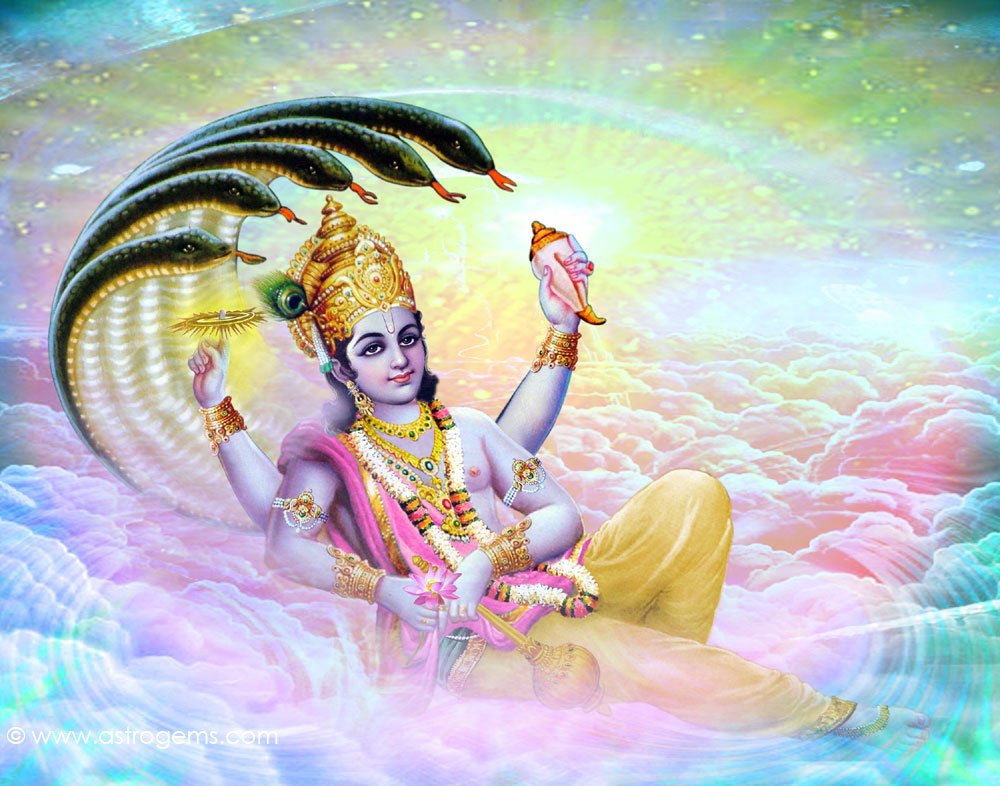
This has been one of the difficult forum topics to meditate upon. The manifestations of various forms of the Lord such as virat-rupa, arca-vigraha, etc. are actually a mercy of the Lord upon the conditioned living entities. These manifestations are actually meant for the neophyte devotees who may have difficulty in immediately accepting the transcendental eternal form of the Lord.

Lord Kṛṣṇa exhibited this virāṭ or viśva-rūpa to Arjuna just to convince the impersonalists that He is the original Personality of Godhead… The virāṭ-rūpa is not, therefore, an eternal form of the Lord exhibited in the spiritual sky; it is a material manifestation of the Lord. The arcā-vigraha, or the worshipable Deity in the temple, is a similar manifestation of the Lord for the neophytes. But in spite of their material touch, such forms of the Lord as the virāṭ and arcā are all nondifferent from His eternal form as Lord Kṛṣṇa.” (SB 3.6.4 P)

This virat-rupa of the Lord was especially manifested, not for the benefit of Arjuna, but for that unintelligent class of men who accept anyone and everyone as an incarnation of the Lord and so mislead the general mass of people. For them, the indication is that one should ask the cheap incarnation to exhibit his virat-rupa and thus be established as an incarnation.” (SB 2.1.24 P)

We also know that Krsna displayed His universal form to Arjuna (on the battlefield) and Yasoda (when she asked Krsna to open His mouth to check if He has eaten dirt). The question to ponder is, if the virat-rupa forms are meant for the less intelligent, why would Krsna display them to Arjuna and Yosada – His pure devotees. The reason is mentioned in BG Chapter 11 (The Universal Form).

The Lord can understand also that Arjuna wants to see the universal form to convince others. Arjuna did not have any personal desire for confirmation. Kṛṣṇa also understands that Arjuna wants to see the universal form to set a criterion, for in the future there would be so many imposters who would pose themselves as incarnations of God. The people, therefore, should be careful; one who claims to be Kṛṣṇa should be prepared to show his universal form to confirm his claim to the people.” (BG 11.3 P)

There are numerous places in the scriptures where the Lord displayed His universal form. One such instance is where Lord Vamanadeva displayed the universal form to Bali Maharaja.

Vāmanadeva first expanded Himself to the universal form and then reduced Himself to the original Vāmana-rūpa. Thus, He acted exactly like Lord Kṛṣṇa, who, at the request of Arjuna, first showed His universal form and later resumed His original form as Kṛṣṇa. The Lord can assume any form He likes, but His original form is that of Kṛṣṇa (kṛṣṇas tu bhagavān svayam). According to the capacity of the devotee, the Lord assumes various forms so that the devotee can handle Him. This is His causeless mercy.” (SB 8.21.5 P)

In another instance, Sri Caitanya Mahaprabhu showed the universal form to His intimate devotees. Sri Caitanya-caritamrita (Adi 17.10) briefly mentions that Advaita Acharya had a vision of the virat-rupa. Sri Caitanya-bhagavata (Madhya 14) elaborates, saying that both Sri Advaita and Nityananda Prabhu were privy to this confidential manifestation of the Supreme and upon seeing it danced like jubilant peacocks. They felt that because of this form the world would now become aware of Lord Caitanya’s divinity.

My personal realization from this lesson is that it teaches us to be humble and fully dependent on Krsna. A lot of simple things that we take for granted such as opening and closing of our eyes, breathing in and out, etc. are actually made possible by the power of the Supreme Lord. He has empowered each controlling demigod to help us with the functioning of these senses. This proves that we living entities do not have power to do anything. Everything comes from the Supreme Lord. Therefore we must seek guidance from the Supreme Lord for everything just as the demigods did. We must align our plans with His plan. The Lord can reveal Himself only to a person who is submissive and who engages in His transcendental loving service. The demigods controlling the elements and ingredients of universal affairs prayed to the Lord for guidance, and thus He manifested His gigantic form, as He did at the request of Arjuna.

All glories to Srila Prabhupada!

Universal Form of the Lord

SB 3.5.45-51: How the Prayers of the Demigods Can Enlighten Us With Sambandha-jñāna

Hare Krsna,

According to the Vedic principles, there are three stages of spiritual advancement, namely, sambandha-jnāna, abhidheya and prayojana. Sambandha-jnāna refers to establishing one’s original relationship with the Supreme Personality of Godhead; abhidheya refers to acting according to that constitutional relationship; and prayojana is the ultimate goal of life, which is to develop love of Godhead (premā pum-artho mahān). If one adheres to the regulative principles under the order of the spiritual master, he very easily achieves the ultimate goal of his life. A person who is addicted to the chanting of the Hare Kṛṣṇa mantra very easily gets the opportunity to serve the Supreme Personality of Godhead directly. (CC Adi 7.73P)

Sambandha-jnana basically means knowledge of one’s spiritual identity and his eternal relationship with Sri Krishna. Srila Prabhupada writes, “Madana-mohana, Sanatana Gosvami’s Deity, helps us progress in Krishna consciousness. In the execution of Krishna consciousness, our first business is to know Krishna and our relationship with Him, which we can learn by worshiping the Madana-mohana vigraha.

In essence, our relationship with Krsna is like that of servant and the served (or master). A jiva is a servant of the Supreme Lord who is the Supreme Master. He is the Lord of everything.

ekale īśvara kṛṣṇa, āra saba bhṛtya

yāre yaiche nācāya, se taiche kare nṛtya

Lord Kṛṣṇa alone is the supreme controller, and all others are His servants. They dance as He makes them do so. (CC Adi 5.142)

In the prayers of the demigods, we see that the same mood of service is highlighted. They are very much aware of the fact that they are the servants of the Supreme Lord.

In SB 3.5.49, the demigods pray, “O unborn one, please enlighten us regarding the ways and means by which we can offer You all enjoyable grains and commodities so that both we and all other living entities in this world can maintain ourselves without disturbance and can easily accumulate the necessities of life both for You and for ourselves.

This is the mood of the servant. The demigods want to offer their service to Krsna. In the purport, Srila Prabhupada remarks, “Such demigods are always ready to render service to the Supreme Lord because they are perfectly aware of the fact that every living entity is constitutionally an eternal subordinate servitor of the Lord. They also know that it is the Lord only who can maintain all living entities with all the necessities of life.

In the next verse (SB 3.5.50), the demigods pray, “You are the original personal founder of all the demigods and the orders of different gradations…” This again shows that the Lord is the original father of all living entities. Srila Prabhupada again highlights the sambandha-jnana, “Every living entity, however great he may be, even up to demigods like Brahmā and Indra, is an eternally subordinate servitor of the supreme father.

In the next verse (SB 3.5.51), it is mentioned that the jīva-tattvas are separated expansions of the viṣṇu-tattvas, and although the jīvas have different potencies, they are all meant for the transcendental sense gratification of the Supreme Lord. Keeping this in mind, the demigods are asking the favor of the Lord for the intelligence and power to carry out their task.

The key takeaway for me from the demigods prayers is how to exercise my free-will. Should I use it for my own sense gratification or for the satisfaction of the Supreme Lord? There is no running away from the fact that we all have to serve. Question is, who do we serve? We serve our family, our society, our nation, our senses, etc. But if we serve those who are related to us through our temporary body, we come under the illusory energy of the Lord and become subjected to the sufferings instigated by the three modes of material nature. However if we serve the Supreme Lord, we come under His internal energy where maya (illusory energy) has not jurisdiction. As a result, we become free from material entanglement and eventually achieve a state of eternity, knowledge, and bliss.

Any conditioned soul may also engage in the service of the Lord under the guidance of an expert spiritual master and thus gradually become freed from the entanglement of material existence. The spiritual master is the manifested representative of the Lord, and anyone who puts himself under the guidance of a spiritual master and acts accordingly is said to be acting in terms of buddhi-yoga.” (SP Purport on SB 3.5.51)

Therefore, the answer is obvious. We are eternal servants of the Supreme Lord and our constitutional duty is to serve Him. This is what the prayers of the demigods is conclusively establishing the sambandha-jnana.

All glories to Srila Prabhupada!

SB 3.5.37-44: Meditating on the Lord’s Lotus Feet

Hare Krsna,

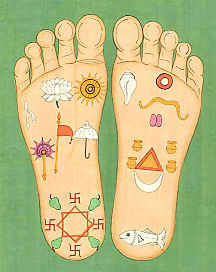
It is a matter of divine coincidence that over the last few days as I have been trying to meditate on Krsna’s lotus feet and the various divine signs on Their soles, our teacher posted this meditation topic (as well as the picture of Krsna’s lotus feet with Their signs). As I am still in the process of compiling what each sign is means, I think it will be premature to list them all in this forum post. When I am done with my notes, I will post them in some future relevant forum post.

From meditation on the Lord’s lotus feet standpoint, one harsh truth I realized is that as I try harder to meditate on Krsna’s lotus feet, maya attacks even more. It is as if she doesn’t not want me to achieve the ultimate perfection of attaining shelter of the Lord’s lotus feet that every pure devotee aspires for. I know maya is kind and is just trying to test me. Hope my determination will come out successful. I pray for all you devotees’ blessings and mercy so that I may be successful in meditating on our Lord’s beautiful lotus feet.

Srimad Bhagavatam is full with the descriptions and benefits of the meditation on Lord’s lotus feet. Below are some of my favorite quotes on His lotus feet.

  • When a devotee wants to see the transcendental form of the Lord, he begins his meditation on the Lord’s body by first looking at the feet of the Lord. (SB 4.24.52p)
  • By his constitutional position, Lord Siva is always great and auspicious, but since he has accepted on his head the Ganges water, which emanated from the lotus feet of the Lord, he has become even more auspicious and important. The stress is on the lotus feet of the Lord. A relationship with the lotus feet of the Lord can even enhance the importance of Lord Siva, what to speak of other, ordinary living entities. (SB 3.28.22p)
  • The pure devotees are always hankering after the lotus feet of the Lord. The lotus has a kind of honey which is transcendentally relished by the devotees. They are like the bees who are always after the honey. Srila Rupa Gosvami, the great devotee acharaya of the Gaudia-Vaishnava-sampradaya, has sung a song about this lotus honey, comparing himself to the bee: “O my Lord Krishna, I beg to offer my prayers unto You. My mind is like the bee, and it is after some honey. Kindly, therefore, give my bee-mind a place at Your lotus feet, which are the resources for all transcendental honey. I know that even big demigods like Brahmä do not see the rays of the nails of Your lotus feet, even though they are engaged in deep meditation for years together. Still, O infallible one, my ambition is such, for You are very merciful to your surrendered devotees. O Mädhava, I know also that I have no genuine devotion for the service of Your lotus feet, but because Your Lordship is inconceivably powerful, You can do what is impossible to be done. Your lotus feet can deride even the nectar of the heavenly kingdom, and therefore I am very much attracted by them. O supreme eternal, please, therefore, let my mind be fixed at Your lotus feet so that eternally I may be able to relish the taste of Your transcendental service.” The devotees are satisfied with being placed at the lotus feet of the Lord and have no ambition to see His all-beautiful face or aspire for the protection of the strong arms of the Lord. They are humble by nature, and the Lord is always leaning towards such humble devotees. (SB 1.11.26p)
  • One who has taken shelter of the lotus feet of the Lord need not cross over the ocean, for he has already crossed it by virtue of his position at the Lord’s lotus feet. (SB 4.23.39p)
  • To meditate upon the lotus feet of the Lord means to become free from the effects of all previous sins. The principle is that one should not willingly commit any sin in his life and should constantly remember the lotus feet of the Lord without deviation. Only in such a mood will the Lord help the devotee make regular progress toward the path of liberation and thus attain the lotus feet of the Lord. (SB 1.19.7p)
  • By hearing and chanting of the glories of the Lord or the Lord’s devotee, one can become firmly fixed in the service of the lotus feet of the Lord. (SB 4.23.39p)

Devahuti prays, “As the Supreme Personality of Godhead, You have taken birth from my abdomen. O my Lord, how is that possible for the supreme one, who has in His belly all the cosmic manifestation? The answer is that it is possible, for at the end of the millennium You lie down on a leaf of a banyan tree, and just like a small baby, You lick the toe of Your lotus foot.” (SB 3.33.4)

All glories to Srila Prabhupada!

SB 3.5.27-36: How the Five Gross Elements are Created by Krsna’s Glance

Hare Krsna,

I was just meditating on the fact that just as the glance of the Supreme Lord is the active ingredient that creates the five gross elements, the same glance of the Lord transforms material to spiritual. For example, the bhoga we offer to the Lord is transformed from mundane food to spiritual remnants (prasadam). Speaking about the five gross elements, I have heard in one class (I do not remember which class) that the offering of five ingredients to the Lord during the arati ceremony also involves these five gross elements. The offering of incense (dhoop) and flower (pushpa) denotes offering of the earth element through fragrance (smell). The offering of water denotes the offering of the water element. The offering of lamp (dipa) denotes the offering of the fire element. The offering of chamar (yak-tail) denotes the offering of the air elements. The offering of the handkerchief denotes the offering of the ether element. The sound of conchshell and bell denotes the offering of the ether (sound) element. I could not understand how the offering of these five gross elements to the Lord transform them from material to spiritual. This arcanam process also transforms the devotee from mundane platform to spiritual platform. All by the merciful glance of the Lord. Bhakti-yoga is such a beautiful and perfect process that everything can be dovetailed in the service of the Lord. The result is that we get purified, satisfied, and transformed to a better devotee.

The merciful glance of the Lord is, therefore, so desirable and pleasing. If we earnestly pray to Krsna for His merciful glance, He can transform our material conditioned existence to a pure transcendental existence. This merciful glance of the Lord reminds of the Bhismadeva’s prayers in the first canto.

In one of the prayers, Bhismadeva prays: In obedience to the command of His friend, Lord Śrī Kṛṣṇa entered the arena of the Battlefield of Kurukṣetra between the soldiers of Arjuna and Duryodhana, and while there He shortened the life spans of the opposite party by His merciful glance. This was done simply by His looking at the enemy. Let my mind be fixed upon that Kṛṣṇa. (SB 1.9.35)

Lord Krsna’s merciful glance is considered as cool as a lotus flower. In the Kṛṣṇa-karṇāmṛta, Bilvamangala Thakura wrote, “If I become thoroughly bathed by Your merciful glance, then I may be saved. Therefore, my Lord, I am requesting You to please bestow upon me Your merciful glance.

In the Kṛṣṇa-karṇāmṛta it is also said, “My dear Lord, You are the ocean of mercy. With my arms placed upon my head, I am bowing down before You with all humility and sincerity. I am praying unto You, my Lord. Would You be pleased just to sprinkle a little of the water of Your glance upon me? That will be a great satisfaction.

Therefore, one must always hanker for the merciful glance of Krsna. The best method to beg Krsna for such mercy is to constantly chant His holy name – kirtaniya sada harih – in a humble mood.

All glories to Srila Prabhupada!