SB 10.22.13-19: Following Kṛṣṇa’s Instructions Require Surrender

Hare Krsna,

Lord Krsna’s supreme instruction in Bhagavad-Gita (18.66) is to abandon all varieties of religion and just surrender unto Hiṃ. While this sounds straight forward but difficult, what is little known is the test one has to go through to prove one’s complete surrender to Krsna. This is also partly a reason why many people fear surrendering. What do they have to go through? What do they have to give up? Therefore, Krsna assures Arjuna, “mā śucaḥ. Do not fear.”

Depending on one’s devotional aspiration and stage of bhakit, one’s test of surrender would be different. The test the gopis went through is the highest epitome of surrender. Of course, their aspiration is also the highest. They wanted Krsna as their beloved husband. They wanted the highest rasa with Krsna – madhurya rasa. Therefore, the test that Krsna put them through is both highest and extreme. It is relatively easier to give up one’s body, wealth, possessions, family, mind, heart, etc. to surrender to Krsna. But what is the greatest wealth a woman could possess? It’s her chastity. Giving up chastity is worse than death for a respectable woman. In traditional India deeply rooted in Vedic culture, dishonor is worse than death. We often hear cases where a woman gives up her life if she is molested, raped or falsely accused to adultery. This is also a reason why many Indian women cover their heads and faces with a dupatta or sleeve of her saree to protect being seen by opposite sex. Similar practices exist in other cultures too. Pious Muslim women cover themselves with an abaya/burka and hijab. Christian nuns also cover their heads as a symbol of piety and modesty. This practice is known as Christian veiling. In essence these women are protecting their chastity. And Krsna is basically asking the gopis, “Are you ready to give up Your shyness and chastity to attain Me as your husband?”

According to Srila Visvanatha Cakravarti Thakura’s commentary on verse 15, the gopis said, “We, being Your maidservants, will carry out Your word. Moreover because You are very beautiful we have to become Your servants, and thus under the guise of being servants, we will offer our very selves to You.

Krsna, in response, is saying, “Very well! Prove your truthfulness!”

Kṛṣṇa then spoke, “We will now test the truthfulness of your words. If you are really My servants, then you will do whatever I say. Please come forward with a smile and take your clothes. If you are not true to your words and fail this test of dharma, then I will not return your clothes.” (Text 16)

The gopis felt trapped.

“The gopis talked among themselves, “O sakhis! We have been defeated by our own words. Now, if we delay any longer some other man may come along, and then we will be sunk in an ocean of shame. Our desire to touch Kṛṣṇa’s body has become even stronger, and cannot be put to death even by drowning in the water. Therefore it seems our fate has been written on our foreheads, and we can do nothing to change it. Therefore, yielding to His demands, we must put aside our embarrassment, send our obstinacy to hell and close our eyes. In that darkness we will cover our bodies and rise up from the water.” (Text 17)

Thus assuring each other that there was no alternative, the gopis rose up out of the water to meet Kṛṣṇa.

Feeling satisfied with pure unalloyed love (sudda-bhāva) of the gopis,  Krsna thought, “Out of love for Me these gopis have done something which is very difficult for any woman. But there remains something even more difficult, and I wonder if they can do it? Now let Me test the power of their love.” 

In a way, Krsna is also going through His own test of surrendering to His pure unalloyed devotees. He is wondering, “Out of love for Me these gopis have done something which is very difficult for any woman. But there remains something even more difficult, and I wonder if they can do it? Now let Me test the power of their love.” (Text 18)

And then Krsna said to the gopis, “O gopis, you have said that you are My servants, and that you will follow My words. Now I am going to test you. If you come out of the water and stand before Me, I will give you your clothing along with My body, mind and soul.” (Text 18)

Thus we see that this surrendering process is mutual and reciprocal. Krsna is also willing to give up Himself – His body, mind and soul to His fully surrendered devotees. And in this sweet exchange of surrender, it is the devotee who ultimately wins. And it reaches a point where Krsna has nothing more to offer, leading to the famous verse na pāraye ’haṁ.

 I am not able to repay My debt for your spotless service, even within a lifetime of Brahmā. Your connection with Me is beyond reproach. You have worshiped Me, cutting off all domestic ties, which are difficult to break. Therefore please let your own glorious deeds be your compensation.” (SB 10.32.22)

Mundane people often misinterpret this beautiful pastime as another example of Krsna’s lusty behavior. Serious and sincere sadhakas will see this as a great lesson in humility and total surrender to the most desirable Personality – Sri Krsna.

We chant the Holy Name with the prayer, ”O Radhe, O Krsna, please engage me in Your service.” Krsna will ask, “What can you give up to attain My service?” Are we ready to completely surrender like the gopis, giving up even our most precious wealth (like shyness and chastity)? Deep points to ponder!!!

All glories to Srila Prabhupada!

SB 10.22.1-12: The Gopīs Worship A Demigod, Goddess Kātyāyanī

Hare Krsna,

Generally, people go to the demigods for material benefit, as indicated in Bhagavad Gita 7.20:

kāmais tais tair hṛta-jñānāḥ prapadyante ’nya-devatāḥ
ta
ṁ taṁ niyamam āsthāya prakṛtyā niyatāḥ svayā

“Those whose intelligence has been stolen by material desires surrender unto demigods and follow the particular rules and regulations of worship according to their own natures.”

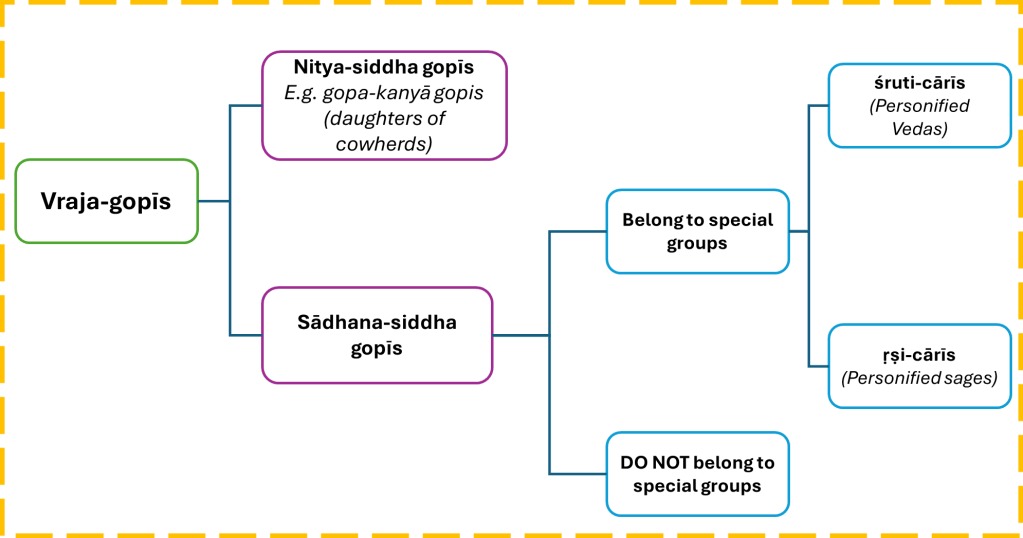
In this pastime we see that the gopīs of Vṛndāvana were performing Kātyāyanī-vrata, a vow dedicated to Goddess Kātyāyanī (a form of Durgā) to attain Śrī Kṛṣṇa as their husband. Does it imply that they are (a) worshipping a demigoddess for (b) some material benediction? In the case of Vraja-gopis, both these factors are incorrecṭ.

We cannot say that the gopis worshipped Kayayani devi for some material benedictioṇ. Their intent was not material but purely spiritual—to serve Kṛṣṇa in the most intimate mood of madhurya-rasa (conjugal love). This is stated in Śrīmad-Bhāgavatam 10.22.4:

Each of the young unmarried girls performed her worship while chanting the following mantra. “O goddess Kātyāyanī, O great potency of the Lord, O possessor of great mystic power and mighty controller of all, please make the son of Nanda Mahārāja my husband. I offer my obeisances unto you.

The Pracetās received benediction from Lord Śiva, and as a result they attained the shelter of the lotus feet of Lord Viṣṇu. This is real benediction. The gopīs also worshiped Lord Śiva in Vṛndāvana, and the lord is still staying there as Gopīśvara. The gopīs, however, prayed that Lord Śiva bless them by giving them Lord Kṛṣṇa as their husband. There is no harm in worshiping the demigods, provided that one’s aim is to return home, back to Godhead.” (4.30.38 Purport)

Therefore, it is not at all wrong on the part of the Vraja-gopis to worship Katayani devi. As long as the end goal is to obtain Krsna, such worship is valiḍ.

Generally, people worship goddess Durgā for some material benediction. Here, the gopīs prayed to the goddess to become wives of Lord Kṛṣṇa. The purport is that if Kṛṣṇa is the center of activity, a devotee can adopt any means to achieve that goal. The gopīs could adopt any means to satisfy or serve Kṛṣṇa. That was the superexcellent characteristic of the gopīs.” (Krsna book, 22)

The second point regarding Katayani devi being a demigod is addressed elaborately by Srila Visvanatha Cakravarti Thakura.

The goddess Durgā mentioned in this verse is not the illusory energy of Kṛṣṇa called Maha-maya but rather the internal potency (cit-sakti) of the Lord known as Yoga-māyā We can thus understand that the internal and external potencies of the Supreme Lord are personified as Yoga-māyā and Mahā-māyā, respectively…  To confuse the Yoga-maya Durga with the Maha-maya Durga is a mistake. Furthermore, although the pastimes of Vraja are on the platform of pure transcendence (suddha-sattva), they somewhat resemble material pastimes in appearance. Therefore, there is no fault in the gopis’ worship of Durga or Maha-maya. Independent thinkers who think that the name of Durga and Maha-maya refer exclusively to the external potency of the Lord have no chance of getting even a touch of the breeze carrying the scent of prema on their body. This is from Vaisnava-tosani by Śrīla Sanātana Gosvāmī.” (SVT commentary on SB 10.22.4)

Therefore the Vraja-gopis were not actually worshipping a demigod by Yoga-maya – the internal potency of the Lorḍ. This shows that their worship is completely spiritual and there is nothing material in their mode of worship and intentioṇ.

As an interesting sidenote, it is mentioned in Brhad Vaisnava Tosani (Srila Sanatana Goswamiś commentary on the 10th Canto) that according to Padma Purana, in a previous birth these girls had been sages during the time of Lord Rama. From that context, their desire to obtain Krsna as their husband is completely appropriate.

All glories to Srila Prabhupada!

SB 10.21.17-20: SB 10.21.17-20: Venu-gīta, Part Three

Hare Krsna,

Growing up in India, we had a conception (or misconception) that samadhi is a deep state of consciousness achieved only through meditation. We would visualize yogis sitting in the Himalayas, eyes closed, legs folded in an asana pose, head, neck and trunk in a straight line. In Buddhism, samadhi is the last of the eight steps leading to enlightenment. From Vedic standpoint, samadhi is the final stage of eight-fold astanga yoga. We had this belief that only rare souls achieve the stage of samadhi after prolonged meditation. Think of Lord Buddha.

However, in Krsna consciousness, Srila Prabhupada gives a totally different understanding of samadhi. He says that samadhi is smartavyaṁ satato viṣṇu – always remembering Visnu or Krsna. Being Krsna conscious 24/7 is samadhi. If we are fully Krsna conscious, that is samadhi. Samadhi is not restricted to dhyana (meditation) stage. We can be in samadhi even when we are physically active throughout the day – engaging in devotional service such as chanting, hearing, remembering, doing services at the temple, book distribution, cooking, cleaning, etc. This is a stage that anyone practicing Krsna bhakti can attain; it is not restricted to selected few like the yogis.

In this lesson on Venu-gita, we can practically see how the gopis are in samadhi – always thinking about Krsna and His pastimes.

While Kṛṣṇa was engaged in tending the cows in the forest of Vṛndāvana or on Govardhana Hill, the gopīs in the village were always absorbed in thinking of Him and discussing His different pastimes. This is the perfect example of Kṛṣṇa consciousness: to somehow or other remain always engrossed in thoughts of Kṛṣṇa. The vivid example is always present in the behavior of the gopīs; therefore Lord Caitanya declared that no one can worship the Supreme Lord by any method which is better than the method of the gopīs. The gopīs were not born in very high brāhmaṇa or kṣatriya families; they were born in the families of vaiśyas, and not in big mercantile communities but in the families of cowherd men. They were not very well educated, although they heard all sorts of knowledge from the brāhmaṇas, the authorities of Vedic knowledge. The gopīs’ only purpose was to remain always absorbed in thoughts of Kṛṣṇa.(Krsna book, Chapter 21)

Krsna says in BG 9.34 – man-manā bhava. Engage your mind always in thinking of Me. Elsewhere in BG 6.47, Krsna again says “And of all yogīs, the one with great faith who always abides in Me, thinks of Me within himself and renders transcendental loving service to Me – he is the most intimately united with Me in yoga and is the highest of all. That is My opinion.” Srila Prabhupada explains in the purport that to become Kṛṣṇa conscious is the highest stage of yoga. If one is fortunate enough to come to the point of bhakti-yoga, it is to be understood that he has surpassed all other yogas.

And how did the gopis attain the platform of samadhi? Srila Visvanatha Cakravarti Thakura writes (in text 20) that the gopis attained the platform of being filled with Kṛṣṇa by describing Kṛṣṇa’s flute playing, forest rambling and cow herding pastimes. The gopis would take one aspect of Krsna and meditate on it, speak about it and share it with others. In this chapter, they described Krsna’s flute, about its good fortune, and how its sweet sound mesmerized every living and non-living entity (the birds, cows, rivers, trees, deer, the gopis themselves, etc.). This is how we can remain absorbed in Krsna. Samadhi means “fixed mind.” When the mind is fixed in meditating on Krsna’s name, form, quality, paraphernalia, pastime, abode, etc., it can be said to be in samadhi. Just like the way the gopis were fixated in Krsna’s flute.

If we read the chapter carefully, we will find a nectarian instruction left behind for us by the gopis on how to follow in their footsteps to attain the stage of Krsna samadhi. They advise that we should take shelter of great devotees to have our desires fulfilled.

The gopis talk among themselves, “O sakhis! Without taking shelter of a great devotee our desires will never be fulfilled. We have heard from Gargi [daughter of Gargamuni] about the glories of Hari’s devotees, and that Govardhana Hill is the best amongst them. Therefore, let’s go there today, bathe in Manasa Ganga, and take darsana of Harideva, the presiding deity of that place. Certainly even our elders will not object to this. Moreover, Kṛṣṇa is playing on the slope of Govardhana.” (SVT commentary on Text 18)

Thus narrating to one another the playful pastimes of the Supreme Personality of Godhead as He wandered about in the Vṛndāvana forest, the gopīs became fully absorbed in thoughts of Him. (SB 10.21.20)

All glories to Srila Prabhupada!

SB 10.21.11-16: Venu-gīta, Part Two

Hare Krsna,

The Vraja gopis’ separation from Krsna in this lesson is a great lesson on humility. Gopi-bhava refers to the extraordinary loving sentiments manifest in the hearts and demeanor of the gopis of Vrajadham, Sri Vrindavan. Caitanya Mahāprabhu said, ramyā kācid upāsanā vraja-vadhu-vargeṇa yā kalpitā (Caitanya-manjusa): there is no more better worship than what was conceived by the gopīs. So gopīs are the topmost devotees. There is no comparison with the devotion of the gopīs.

But here we see the gopis’ extreme humility and lamentation in separation from Krsna. They are all situated in madhurya-rasa (the highest rasa) – the most coveted rasa among the Gaudiya Vaisanavas – and still they think they are the most unfortunate. Rather they praise the devotees situated in other rasas about their good fortune to see and serve Krsna. There is not a tinge of pride in the gopis. They are the living manifestation of ‘trnad api sunicena’ principle.

The gopis praise the bucks and the does (husband and wife deers) because not only are they attracted by the dress of Kṛṣṇa and Balarāma, but as soon as they hear the playing of the flute, they deer offer respectful obeisances unto the Lord by looking at Him with great affection. The gopīs thought themselves not so fortunate because whenever they wanted to go to Kṛṣṇa, their husbands were not very happy. The deer may be considered situated in santa-rasa. (SB 10.21.11)

The gopis never think, “Oh! Krsna belongs to us. He will come to us eventually. Do not worry. Let’s get on with our chores.” No, they don’t think like that. They are in extreme separation from Krsna as if their life depends on Him.

Next the gopis praise the demi-goddesses and demigods. They may be considered situated in dasya-rasa. The gopis are amazed that even the demi-goddesses become mad after Kṛṣṇa seeing His exquisite form and sterling qualities. (SB 10.21.12)

Next the gopis praise the cows and calves because even they know how to cry for Kṛṣṇa and embrace Him heart to heart. They know the transcendental art of hearing the sweet sound of Kṛṣṇa’s flute. (SB 10.21.13)

Srila Prabhupada says in Nectar of Devotion 9 that “One should learn how to cry for the Lord. One should learn this small technique, and he should be very eager and actually cry to become engaged in some particular type of service. This is called laulyam, and such tears are the price for the highest perfection. If one develops this laulyam, or excessive eagerness for meeting and serving the Lord in a particular way, that is the price to enter into the kingdom of God.”

The gopis are marveling that the cows and calves have unalloyed pure love for Kṛṣṇa because they can meet Kṛṣṇa. The cows can be considered situated in vatyalsa-rasa.

It is said that an uttama adhikari devotee thinks that, except for himself/herself, everyone else is a pure devotee of Krsna. This is the same mood manifested by the gopis. They think that all other living entities have unalloyed love for Krsna. They compare the birds to munis (sages) because they live in the forest, keep their eyes closed, observe silence and remain motionless. They say thateven the branches of the trees are transformed in ecstasy when struck by the vibration of Kṛṣṇa’s flute-song, and begin to sprout new leaves out of ecstasy. 

Next the gopis praise the river Yamuna because she, “being desirous to embrace the lotus feet of Kṛṣṇa after hearing the transcendental vibration of His flute, broke her fierce waves to flow very nicely with lotus flowers in her hands, just to present flowers to Mukunda with deep feeling.” (SB 10.21.15)

Next the gopis praise the clouds because it constructed out of his own body, with its multitude of flower-like droplets of water, an umbrella to shield Krsna and Balarama from the intense heat of the sun. In this way the cloud gives pleasure to Kṛṣṇa, but they (the gopis) do not get an opportunity to please Him. The clouds can be considered situated in sakhya-bhava. (SB 10.21.16)

Śrī Caitanya Mahāprabhu had assumed the mood of the gopīs, so much so that everywhere He looked He saw Kṛṣṇa standing with His flute to His lips. Absorbed in the ecstatic mood of the gopīs, Śrī Caitanya Mahāprabhu wandered here and there. He began to inquire after Kṛṣṇa by quoting verses to all the trees and creepers.” (CC Antya 14.32 and CC Antya 15.31)

In this connection, one prayer by Rūpa Gosvāmī is sufficient to exemplify this hopefulness. He says, “I have no love for Kṛṣṇa nor for the causes of developing love of Kṛṣṇa—namely, hearing and chanting. And the process of bhakti-yoga, by which one is always thinking of Kṛṣṇa and fixing His lotus feet in the heart, is also lacking in me. As far as philosophical knowledge or pious words are concerned, I don’t see any opportunity for me to execute such activities. But above all, I am not even born of a nice family. Therefore I must simply pray to You, Gopī-jana-vallabha (Kṛṣṇa, maintainer and beloved of the gopīs). I simply wish and hope that some way or other I may be able to approach Your lotus feet, and this hope is giving me pain, because I think myself quite incompetant to approach that transcendental goal of life.” The purport is that under this heading of āśā-bandha, one should continue to hope against hope that some way or other he will be able to approach the lotus feet of the Supreme Lord. (Nectar of Devotion, 18)

In this way, the gopis are teaching us that we should never consider ourselves advanced devotees but rather should think that we are not devotees at all. Everyone has love for Krsna except us. In line with Mahaprabhu’s teachings, we should remain humble always and remember Krsna in separation.

The gopis’ mood is very relevant to me personally because they lament that they are not able to see and meet Krsna because of being held back in their homes due to responsibilities towards their husband, children and family. But still, they are able to remember Krsna every moment. I am also unable to serve Krsna consistently due to job and other responsibilities. Thus, the gopis example is a great example of serving Krsna in remembrance.   

All glories to Srila Prabhupada!

SB 10.21.1-10: Venu-gīta, Part One

Hare Krsna,

Para bhakti or pure bhakti (supreme devotion) means bhakti which follows in the wake of the gopis of Vraja (ramya kacid-upasana vrajavadhu-vargena ya kalpita). This lesson on Venu-Gīta (song of the flute of Krsna) shows us the art of thinking, feeling, and willing in the mood of the gopis for Krsna. The activities and mood of the gopis in this pastime epitomizes the activities of devotees filled with prema for the Lord.

Thinking: The Vraja gopis are showing us how to always think or meditate on Krsna. Their mood is the mood of separation. We have learned that one should meditate on the name, form, qualities, pastimes, abode of the Lord. The gopis are doing all of these things at the same time. They are meditating on Krsna beautiful form dressed as the best of dancers. They visualize Krsna wearing a peacock-feather upon His head, blue karṇikāra flowers on His ears, a yellow garment as brilliant as gold, and the Vaijayantī garland. They are meditating on how Krsna fills the holes of His flute with the nectar of His lips. They are meditating on the Krsna’s cowherd friends (how they are singing His glories); on the beautiful land of Vrindavan (including the animals, trees and creepers, lakes, mountains, bumble bees, the autumn season). In this way the gopis are teaching us how to attain the perfection of samadhi (trance) – constant remembrance of Krsna.

Persons who are constantly engaged in the transcendental meditation of seeing Kṛṣṇa, internally and externally, by thinking of Him playing the flute and entering the Vṛndāvana forest, have really attained the perfection of samādhi. Samādhi (trance) means absorption of all the activities of the senses on a particular object, and the gopīs indicate that the pastimes of Kṛṣṇa are the perfection of all meditation and samādhi. It is also confirmed in the Bhagavad-gītā that anyone who is always absorbed in the thought of Kṛṣṇa is the topmost of all yogīs.” (Krsna book, Chapter 21)

Feeling: As Krsna enters the forest of Vrndavana with Balarama, cowherd friends, and their cows, and Krsna is playing the flute, the gopis are feeling separation from Him due to staying back at the village. When they heard the song of Kṛṣṇa’s flute, which arouses the influence of Cupid, some of them privately began describing Kṛṣṇa’s qualities to their intimate friends.

Hearing Kṛṣṇa’s flute song, the gopis began describing indirectly to their friends about Kṛṣṇa entering the forest. The word paroksa (indirectly) is used because the gopis were located far away from Kṛṣṇa in the village of Vraja.” (Srila Visvanatha Cakravarti Thakura commentary on Text 3)

Willing: Due to intense separation from Krsna, the Vraja gopis are praising the good fortune of Krsna’s flute and wishing how rather they deserve to have the good fortune that the flute is manifesting, who they think is totally undeserving (being dull, lifeless and unqualified and, moreover, a male). They are willing how their beautiful eyes should realize its purpose by seeing the most wonderful thing there is to see, Kṛṣṇa. Their desire to see Krsna (or even to receive His side-long glance) is so strong that they are willing to abandon all family tradition, shyness and self-control. They desire to see, touch, hear and smell Kṛṣṇa. Due to Krsna surrounded by Balarama and Their friends, the gopis are willing to get a glimpse of Krsna stealthily peering through the leaves of the creepers.

Another gopi said, “O sakhis! We intensely desire to relish Kṛṣṇa’s dancing, singing and flute playing, and to see all those beasts, deer, doves and birds assembled on the hill slopes, who have become stunned in bliss.” (Srila Visvanatha Cakravarti Thakura commentary on Text 10)

Even Srila Visvanatha Cakravarti Thakura expresses that his only goal in life is the Vraja-gopis, who, being attracted by the nectar shower from Kṛṣṇa’s flute ran out of their houses, and whose sweet words repeated here enable us to relish that nectar too. (Srila Visvanatha Cakravarti Thakura commentary on Text 7)

In this way, the supreme Vraja gopis are teaching us how to engage our senses, mind and heart in always remembering Krsna.

In case we feel unqualified to attain the mood and pure bhakti of the gopis, we can take inspiration from Krsna’s flute. Like the flute, I may be dull, lifeless and unqualified for pure devotional service. However by the sound vibration of the Holy Name that exudes from my mouth and enters the ears, minds and heart where Krsna resides, I pray that Krsna will cast His sidelong glance on me and make me as successful as He did with the flute.

“ Then, considering the flute to be dull, lifeless and unqualified for such work, the vibration exudes from its holes and enters the ears and minds of the Vraja-gopis. The implication is that the flute vibration makes itself successful in accomplishing its purpose of fully exhibiting its powers by conquering the Vraja-gopis with Cupid.(Srila Visvanatha Cakravarti Thakura commentary on Text 6)

Thus, this first part of the Venu-gita is a magnificent portrayal of Vraja gopis’ prema, humility, separation from Krsna, appreciation of Vrindavana and everything related to it (animals, trees, water, season, etc.) and a divine lesson for us sadhakas to imbibe and follow. Especially for those devotees who aspire to follow in their footsteps and attain the platform of raganuga-bhakti.

All glories to Srila Prabhupada!

SB 10.20.32-49: From the Rainy Season to Autumn

Hare Krsna,

In this lesson (SB 10.20.32-49), Srila Prabhupada and Srila Visvanatha Cakravarti Thakura beautifully describes the symbolism of the autumn season in relation to spiritual life, drawing parallels between natural transformations and the journey of a devotee in Kṛṣṇa consciousness. It highlights how the cleansing and clarifying effects of autumn—such as the disappearance of clouds, the drying up of muddy water, and the calming of the ocean—reflect the purification and serenity that come with surrender to Kṛṣṇa.

I was meditating on the transition from the rainy season to autumn can also symbolically apply to the chanting the Holy Name in relation to our spiritual life.

With the arrival of autumn, the sky clears, shedding the burden of dark clouds. Similarly, when one takes to the chanting of the Holy Name, the accumulated impurities of lifetimes—lust, anger, and greed—gradually dissipate, revealing the natural brilliance of the soul. Just as the autumn sky regains its vast blue expanse, the heart of a devotee becomes expansive with divine realization, purified by the transcendental sound vibration of the Name.

The rivers and lakes, once muddied by the torrents of the rainy season, settle into clarity with the touch of autumn’s breath. So too, the mind—disturbed by endless worldly desires—finds tranquility when immersed in the melodious recitation of Kṛṣṇa’s Names. The waters of material existence, once agitated by the storms of karma and illusion, become still and reflective, allowing the devotee to see clearly the truth of their eternal relationship with the Lord.

The white autumn clouds, light and free, no longer burdened with torrents of rain, mirror the heart of one who chants sincerely. The worries and anxieties of material life no longer weigh heavily, for the Holy Name of Kṛṣṇa, being non-different from Him, lifts all burdens and grants freedom from entanglement. Just as the aged householder gradually relinquishes worldly responsibilities and dedicates himself to the pursuit of Kṛṣṇa consciousness, the sincere chanter of the Holy Name finds detachment from fleeting pleasures, embracing the eternal joy of spiritual life.

During autumn, waterfalls either flow gracefully with pure water or recede into silence. Likewise, saintly persons, nourished by the nectar of the Holy Name, distribute their wisdom generously or remain absorbed in silent meditation on the Divine. The small creatures who thrive in shallow waters are disturbed when the pools dry up; in the same way, those attached to the temporary gains of material life suffer as time erodes their possessions. But one who takes shelter of the Holy Name transcends this fear, knowing that the wealth of devotion is never lost.

Just as farmers carefully store their harvested grains, recognizing the fleeting nature of the season, a sincere devotee guards the treasure of Kṛṣṇa’s Names, chanting with discipline and devotion. The wise conserve their energy, directing it toward remembrance of the Lord, rather than squandering it on fleeting pleasures. The Holy Name fortifies the soul, ensuring that, in the final season of life, the devotee is prepared to cross beyond the cycle of birth and death.

The scorching heat of the autumn sun reminds us of the exhaustion of material struggle, yet the cooling moonlight mirrors the soothing shelter of Kṛṣṇa’s mercy found in the Holy Name. Just as the gopīs found no solace in the autumn breeze without Kṛṣṇa’s embrace, the devotee finds no true joy in worldly comforts but only in the divine nectar of nāma-saṅkīrtana. The stars shining in the clear autumn sky are like the purified souls who, through constant remembrance of Kṛṣṇa, radiate transcendental wisdom and beauty.

The Holy Name is the ultimate harvest of spiritual life, ripening in the heart of a devoted chanter. Just as the new grains of autumn are first offered to the Lord in gratitude, the fruits of one’s chanting must be offered in selfless service. As autumn signifies renewal and purification in nature, the chanting of the Holy Name signals the soul’s awakening to its eternal home in Kṛṣṇa’s loving embrace.

In the sacred autumn of the soul, let the chanting of the Holy Name cleanse, uplift, and illuminate, until the heart itself becomes as clear as the autumn sky—where only Kṛṣṇa remains.

On deeper reflection, I can draw a parallel between the above comparison of the autumn season to the Holy Name and Sri Caitanya Mahaprabhu’s first verse of Sri Siksastakam.

Let there be all victory for the chanting of the holy name of Lord Kṛṣṇa, which can cleanse the mirror of the heart and stop the miseries of the blazing fire of material existence. That chanting is the waxing moon that spreads the white lotus of good fortune for all living entities. It is the life and soul of all education. The chanting of the holy name of Kṛṣṇa expands the blissful ocean of transcendental life. It gives a cooling effect to everyone and enables one to taste full nectar at every step.” (Sri Siksastakam Text 1 as quoted in CC Antya 20.12)

All glories to Srila Prabhupada!

SB 10.20.21-31: The Rainy Season, Part Three

Hare Krsna,

This lesson is truly delightful to read and meditate upon. It is wonderful to see Kṛṣṇa taking time to marvel at the transcendental forests of Vṛndāvana and the changing seasons. His example teaches us the importance of stepping away from our busy schedules to appreciate the world around us—to marvel at the beauty of Kṛṣṇa’s creation.

I have always felt a deep connection with nature, and seeing that Kṛṣṇa, the Supreme Lord Himself, cherishes every intricate aspect of His own creation is profoundly inspiring. This appreciation for the natural world is not unique to the Vedic tradition; many other faiths also uphold the practice of honoring creation. For instance, if I am not mistaken, the Jewish festival of Shabbat is observed as a day of rest, commemorating the story of creation in the Torah, where God rested on the seventh day after completing the universe. This sacred observance encourages Jews to pause and reflect on the beauty and miracle of the world around them, much like Kṛṣṇa’s own appreciation of Vṛndāvana.

In Śrī Vṛndāvana Mahimāmṛta, a beautiful and profound text composed by Śrīla Prabhodānanda Sarasvatī, there are many instances where the forests (vanas) of Vṛndāvana and the changing seasons are glorified in relation to the divine pastimes of Rādhā and Kṛṣṇa. Throughout the Vṛndāvana Mahimāmṛta, Śrīla Prabhodānanda Sarasvatī repeatedly praises the forests of Vṛndāvana as places of transcendental beauty, decorated with blooming flowers, sweetly singing birds, and fragrant breezes that enhance Kṛṣṇa’s pastimes.

There are many verses that express this transcendental beauty:

Vṛndāvana is naturally free of all flaws; it transforms those who are reservoirs of faults into reservoirs of virtue. May it protect me, who have been excommunicated by every religion, and may it dry up all my terrible sins.” (Vṛndāvana Mahimāmṛta 1.39)

May beautiful Vrindavana, which is filled with cuckoos celebrating a great festival of singing, peacocks happily dancing, the sweetness of the music of bumblebees humming, trees, vines, and flowering-vine pavilions, and which fulfills the desires of Radha-Krishna’s sweet maidservants, appear before me. (Vṛndāvana Mahimāmṛta 19)

Similarly, the seasons in Vṛndāvana are not just natural phenomena; they are divine orchestrations that enhance the rasa-līlā and other pastimes of Śrī Kṛṣṇa.

In the monsoon forests Kṛṣṇa saw the joyful Pulinda women, the honey pouring down the trees, the waterfalls flowing from the mountains, and far off caves, which appeared to be nearby from the echoing sound. When it rained Kṛṣṇa would run and enter the hollow of a tree or a cave and amuse Himself by eating radish. There are two types of radish: round ones and long ones.” (Srila Visvanatha Cakravarti Thakura’s Sārārtha-darśini – 27-28)

Lord Kṛṣṇa watched the contented bulls, calves and cows sitting on the green grass and grazing with closed eyes, and He saw that the cows were tired from the burden of their heavy milk bags. Thus observing the beauty and opulence of Vṛndāvana’s rainy season, a perennial source of great happiness, the Lord offered all respect to that season, which was expanded from His own internal potency.” (SB 10.20.30-31)

In Śrī Vṛndāvana Mahimāmṛta, the forests and seasons of Vṛndāvana are not merely scenic descriptions but deeply connected to Kṛṣṇa’s pastimes. Each season brings a new mood (bhāva) that enhances the mādhurya (sweetness) of Vṛndāvana. The entire land of Vṛndāvana is depicted as a conscious being, completely dedicated to the service of Sri Sri Rādhā and Kṛṣṇa.

All glories to Srila Prabhupada!

SB 10.20.9-20: The Rainy Season, Part Two

Hare Krsna,

There are many practical applications from this lesson (SB 10.20.9-20).

SB 10.20.9: The frogs, who had all along been lying silent, suddenly began croaking when they heard the rumbling of the rain clouds, in the same way that brāhmaṇa students, who perform their morning duties in silence begin reciting their lessons when called by their teacher.

            Similarly, the devotees start strictly following the regulative principles and chanting of the Holy Name by the order of the spiritual master. Everyone is sleeping in the darkness of Kaliyuga, but when there is a great Ācārya like Srila Prabhupada, by his calling only, everyone takes to the study of the Vedas to acquire actual knowledge and executive of devotional service.

During the rainy season, many small ponds, lakes and rivulets become filled with water; otherwise the rest of the year they remain dry. Similarly, materialistic persons are dry, but sometimes, when they are in a so-called opulent position, with a home or children or a little bank balance, they appear to be flourishing, but immediately afterwards they become dry again, like the small rivulets and ponds.” (Krsna; Chapter 19)

            This teaches us that we should not take pride in accumulating material wealth and piety as they are temporary. Real wealth lies in cultivating Krsna consciousness and pure love for Krsna. This ocean of Krsna prema is endless unlike the ocean of material happiness which is no more than a drop of water in the endless ocean of bhakti rasa.

According to the Vedic injunction, eko bahūnāṁ yo vidadhāti kāmān, the Supreme Personality of Godhead maintains this creation; therefore, He arranges for a supply of whatever is required for all living entities. When there is population increase, it is the business of the Supreme Lord to feed them. “(Krsna; Chapter 19)

            This teaches us that we should not overly concern ourselves with bodily needs—such as food, clothing, and shelter—since these are provided by the Supreme Lord’s arrangement. The modern capitalist and consumerist mindset, however, cunningly brainwashes us into believing that resources are scarce, prompting us to hoard.

“In the rainy season, when the rivers swell and rush to the oceans and seas, they appear to agitate the ocean. High mountains, however, although splashed by torrents of rain, do not change; so a person who is advanced in Kṛṣṇa consciousness, even if put into difficulties, is not embarrassed because a person who is spiritually advanced accepts any adverse condition of life as the mercy of the Lord, and thus he is completely eligible to enter into the spiritual kingdom.” (Krsna; Chapter 19)

            Mountains can teach us a lot about tolerance through their steadfastness and endurance. They stand tall and unmoved in the face of storms, weathering harsh conditions over time without breaking down. Similarly, tolerance involves standing firm amidst challenges, conflicts, or differing viewpoints without being easily shaken or losing composure. Mountains show us the importance of patience, resilience, and accepting the ebbs and flows of life, just as they do with the seasons, allowing us to grow stronger through adversity while maintaining our peace and stability. It is important for devotees practicing Krsna consciousness to be steadfast like a mountain because challenges will inevitably come during the course of our bhakti.

During the rainy season the roads, not being cleansed, became covered with grass and debris and were thus difficult to make out. These roads were like religious scriptures that brāhmaṇas no longer study and that thus become corrupted and covered over with the passage of time.” (SB 10.19.16)

            Very instructive lesson for all of us. A devotee who is not accustomed to studying the scriptures (and especially Srila Prabhupada books) will eventually fall into the trap of maya. Similarly, the scriptures will also become neglected and corrupted when no longer studied by the devotees.  It may reach a point where the scriptures will be hidden from human access as it happened with many scriptures in the past. I am very grateful we have a platform for studying and discussing Srila Prabhupada books, and advance in Krsna consciousness.

All glories to Srila Prabhupada!

SB 10.20.1-8: The Rainy Season, Part One

Hare Krsna,

Metaphorically the sky, sun, cloud, earth and the evening darkness can apply aptly to the spiritual master. Just as the sky is covered by dense clouds accompanied by lightning and thunder, the conditioned spirit soul is covered by ignorance caused by entanglement with the three modes of material nature. He suffers the three-fold material miseries and undergoes the repeated cycle of birth, death, old age, and disease. These material miseries are compared to scorching summer heat. He is wandering in this material world looking for little pleasure. However, his situation is just like a criminal who is dunked in the water of material miseries and then taken out briefly for some respite. He considers this momentary respite happiness. By good fortune, he may come in contact with a bonafide representative of the Supreme Lord who is empowered to deliver the jiva from all material miseries.

Out of many millions of wandering living entities, one who is very fortunate gets an opportunity to associate with a bona fide spiritual master by the grace of Kṛṣṇa. By the mercy of both Kṛṣṇa and the spiritual master, such a person receives the seed of the creeper of devotional service.” (CC Madhya 19.151)

Just as the sun absorbs the earth’s water and stores them as cloud for the rainy season, the spiritual master receives benediction from the ocean of mercy.  Just as merciful persons give their lives or wealth for the happiness of society, the spiritual master, disturbed by the conditions of the suffering living entities, delivers the materially afflicted world by extinguishing the blazing fire of material existence. Like a cloud that pours water on a forest fire to extinguish it, the spiritual master removes the blindfold of ignorance and opened the living entities’ eyes with the torch of knowledge. Until then the living entity is like the earth emaciated by the summer heat, or a person emaciated by intense and fruitless austerities. The spiritual master’s pouring of mercy fully nourishes the living entity and thereby receives his desired results. I offer my respectful obeisances unto him.

I was born in the darkest ignorance, and my guru, my spiritual master, opened my eyes with the torch of knowledge. I offer my respectful obeisances unto him.” (Invocation Prayer)

The spiritual master is receiving benediction from the ocean of mercy. Just as a cloud pours water on a forest fire to extinguish it, so the spiritual master delivers the materially afflicted world by extinguishing the blazing fire of material existence. I offer my respectful obeisances unto the lotus feet of such a spiritual master, who is an ocean of auspicious qualities.” (Gurvastakam 1)

Unfortunately, in Kali-yuga pure devotees and true knowledge of the Vedas are overshadowed by bogus gurus and atheistic doctrines. This is compared to evening darkness that allows glow-worms to shine, but not the bright stars. Therefore, it is a matter of great fortune to attain the shelter of a pure devotee of the Supreme Lord, Krsna.

 “O great sage, among many millions who are liberated and perfect in knowledge of liberation, one may be a devotee of Lord Nārāyaṇa, or Kṛṣṇa. Such devotees, who are fully peaceful, are extremely rare.” (SB 6.14.5)

As clouds sometimes clear, even in the rainy season, and sometimes the moon, stars and sun become visible, so even in this Kaliyuga there are sometimes advantages. The Vedic movement of Lord Caitanya’s—the distribution of chanting the Hare Kṛṣṇa mantra—is heard in this way. People seriously anxious to find real life should take advantage of this movement instead of looking toward the light of mental speculators and atheists.” (Krsna Book, Chapter 20)

All glories to Srila Prabhupada!

SB 10.19.1-16: Kṛṣṇa Always Protects His Devotees

Hare Krsna,

As I was studying and meditating on this lesson, I was trying to find the correlation between the pastime and the anartha it represented. According to the anartha chart shared by our teachers, this (and second) forest fire represents ‘disturbance of religious principles and interference with religious people who are atheist’.  But nowhere in the pastime is interference with (or disturbance of) deviant religious principles indicated! I was wondering, where’s the connection?

Thankfully, a devotee brought out the connection beautifully. She wrote, “Misleading a conditioned soul from the path of Krishna consciousness is against religious principles, and by definition atheistic.” The cows were captivated by the allure of ‘greener grass’ on the other side of the dense forest. Similarly, the conditioned souls and sincere sadhakas are presented with various allurements to disturb us from the path of pure Krsna consciousness. More so during the solitary chanting of the Holy Name when the mind treats us with various material attractions that disturb our chanting. These allurements appear in the form of fruitive results, impersonal philosophy, economic development, sense gratification, and liberation. We have also seen “deviation” in the early days of ISKCON where some devotees jumped the ship and joined other Gaudiya lines because they wanted quick results (such as raganuga bhakti, siddha-deha, etc.) without having to undergo the strict regulative principles as prescribed by Srila Prabhupada.

All these allurements are like the forest fire that engulfs us and threatens to destroy our pure bhakti. A vigilant devotee will notice these allurements/deviations and will take appropriate action at the right time before it is too late. We can simply follow the example of the cowherd boys who took shelter of Kṛṣṇa and Balarāma.

[The cowherd boys said:] O Kṛṣṇa! Kṛṣṇa! Most powerful one! O Rāma! You whose prowess never fails! Please save Your devotees, who are about to be burned by this forest fire and have come to take shelter of You! (SB 10.19.9)

Kṛṣṇa! Certainly Your own friends shouldn’t be destroyed. O knower of the nature of all things, we have accepted You as our Lord, and we are souls surrendered unto You! (SB 10.19.10)

Similarly, we must immediately take shelter of Kṛṣṇa and Balarāma (or Gaura Nitai) to protect us from the forest fire of deviant religious principles. We should be so well conversant with the teachings of Srila Prabhupada that any time we come across philosophy that is not in line with his teachings, we must immediately take shelter of him and beg to protect us. I have done this so many times. This is why we must consider ourselves fortunate to study Srila Prabhupada’s books under the proper and expert guidance of our respected teachers (HG Dhruva Maharaja prabhu and HG Mother Samapriya); they have carefully guided and nourished our philosophical understanding, and pointed out any philosophical deviations that we express verbally or in our writings of the forum posts.

Krsna not only protects us physically. He also takes care to protect our bhakti and religious life (dharma) through His bonafide representatives if we surrender to Him sincerely. In return, Krsna will deliver us from these difficulties by immediately bringing us under the cooling shelter of the Bhandira tree (or His lotus feet, or under the protective care of His pure devotees).

Kṛṣṇa said, “Do not fear. Today I will use another means to protect you.” (SVT commentary on SB 10.19.11)

All glories to Srila Prabhupada!